Dr. Gymbro
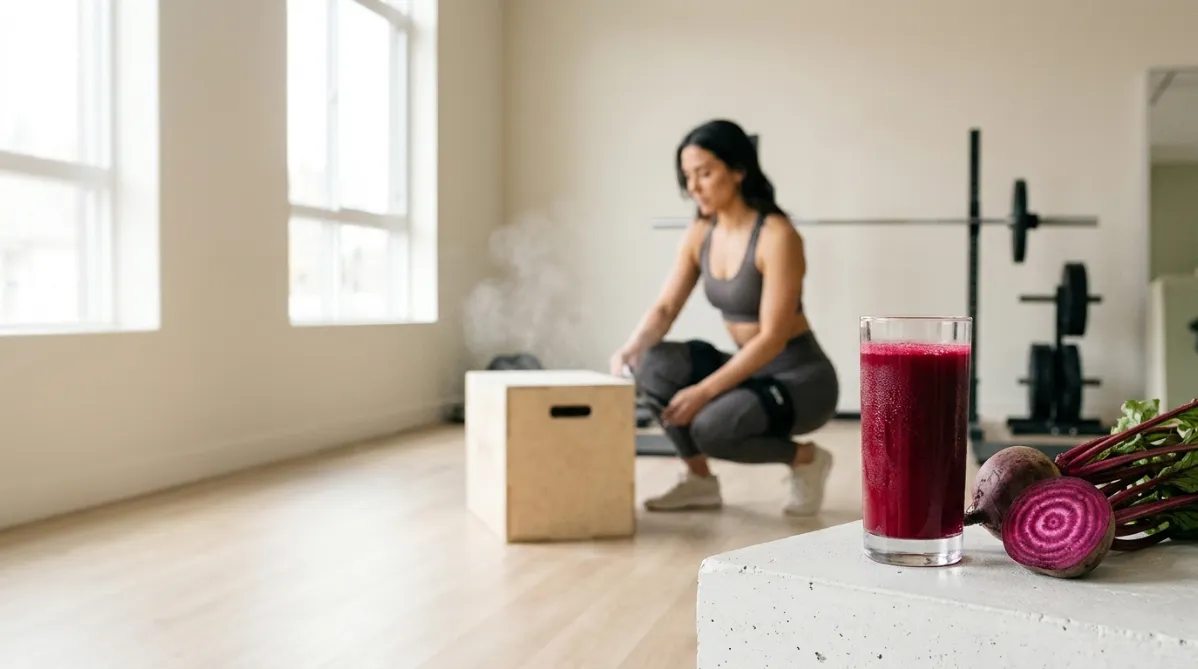
A bright, modern editorial photograph of a minimalist athletic studio with pale oak flooring and soft diffused daylight pouring in from tall windows on the left. In the foreground, slightly off-center to the right, a tall glass of deep magenta-crimson beetroot juice sits on a matte white concrete surface, condensation beading on the glass, a few fresh whole beets with leafy stems and one halved beet showing vivid concentric purple rings arranged beside it. Behind them, softly blurred with shallow depth of field, an athlete in neutral-toned athletic wear (charcoal and cream) crouches mid-prep, with slim black blood flow restriction cuff bands wrapped around the upper thighs. A clean wooden plyo box and a simple barbell rack are subtly visible in the background. A thin arc of chalk dust hangs in the air, suggesting a recent jump. The color palette is restrained and trendy: warm off-white, soft sage green, charcoal gray, with the beetroot magenta as the single bold accent. Composition follows a wide 16:9 landscape layout with generous negative space on the left third for title overlay. Lighting is natural, gentle, and slightly golden, with soft shadows and a subtle film-grain texture. The overall feel is a contemporary wellness and sports science magazine cover: clean, calm, sophisticated, tactile, with crisp detail on the juice and beets and a dreamy blur on the athlete.
Science & Research

Suco de Beterraba + Treinamento BFR: O Salto Sob Fadiga Revela uma Vantagem de Força Ainda Não Explorada

Dr. Gymbro · · 4 min read

A Surpresa: Força Igual nos Dois Grupos, Salto Diferente

Combine suco de beterraba com treinamento de restrição de fluxo sanguíneo (BFR) e espere ganhos de força ainda maiores. Não foi isso que um novo ensaio clínico randomizado, duplo‑cego, publicado no Journal of the International Society of Sports Nutrition encontrou. A força aumentou nos dois grupos; a vantagem do suco de beterraba (BRJ) apareceu na altura do salto contramovimento quando os atletas já estavam fatigados.

Se você já adquiriu suco de beterraba como atalho para força, essa distinção faz diferença. A seguir explicamos o que foi feito, o que foi encontrado e como usar a informação sem exageros.

O Que os Pesquisadores Realmente Fizeram

O estudo recrutou 20 estudantes universitários do sexo masculino de um curso de Educação Física. Eles foram distribuídos aleatoriamente em dois grupos de 10 participantes:

  • BFR apenas (idade média ≈ 21,9 anos)
  • BFR + BRJ (idade média ≈ 21,8 anos)

O grupo BRJ recebeu 8 mmol de nitrato por dia (cerca de 500 mg de nitrato), provenientes de suco de beterraba concentrado. O protocolo começou com uma semana de pré‑suplementação, seguida por quatro semanas de treinamento BFR.

Protocolo de BFR

  • Exercícios: extensão e flexão bilateral do joelho
  • Frequência: três sessões por semana
  • Pressão da cinta: 40 % da pressão de oclusão do membro
  • Carga: 30 % do torque máximo

Trata‑se de carga leve com restrição moderada, a "receita padrão" para obter efeitos de treinamento sem sobrecarga.

Avaliações

  • Força dos extensores e flexores do joelho: dinamômetro isocinético (velocidades de 60°/s, 180°/s e contração isométrica voluntária máxima)
  • Teste de fadiga: 100 repetições a 90°/s
  • Salto contramovimento (CMJ): medido em placa de força, tanto em estado fresco quanto fatigado, antes e depois da intervenção.

Resultados, Sem Hype

  • Força aumentou nos dois grupos. Em quatro semanas de BFR, com ou sem BRJ, o torque pico relativo dos extensores e flexores melhorou nas três velocidades testadas, assim como a força isométrica. O torque durante o teste de fadiga também subiu, tanto nas primeiras 20 quanto nas últimas 20 repetições da série de 100.

  • CMJ bilateral em estado fatigado melhorou nos dois grupos. Altura do salto, força de pico e taxa de desenvolvimento de força aumentaram após BFR e após BFR + BRJ.

  • Sinal específico do BRJ: apenas o grupo BFR + BRJ apresentou aumento estatisticamente significativo na altura do salto bilateral fatigado. Os autores concluíram que os efeitos do BRJ foram "seletivos, e não amplamente superiores". Em resumo, o suco ajudou a reduzir a queda de desempenho no salto vertical causada pela fadiga.

  • O salto unilateral não mudou. Não houve melhora significativa no CMJ unilateral em nenhum dos grupos.

Como Interpretar com Realismo

Trata‑se de um estudo em humanos, mas diversas limitações impedem que ele seja considerado prova definitiva:

  1. Amostra diminuta. Dez indivíduos por grupo configuram um desenho piloto; os tamanhos de efeito podem não se replicar em amostras maiores.
  2. Só homens jovens. Não há dados sobre mulheres, atletas de elite ou pessoas mais velhas.
  3. Significância não equivale a superioridade. "Só o grupo BRJ atingiu significância" não implica que ele tenha superado o grupo BFR‑only em força geral.
  4. Duração curta. Quatro semanas dizem pouco sobre adaptações a longo prazo.
  5. Estatísticas confusas no resumo. Alguns valores (por exemplo, p = 0,23 para a perna esquerda) parecem inconsistentes; vale conferir o texto completo antes de citar números.

Possível Mecanismo

O suco de beterraba é rico em nitrato dietético, que o organismo converte em óxido nítrico. Esse vasodilatador está associado a maior fluxo sanguíneo e à eficiência contrátil muscular. O estudo não mediu diretamente óxido nítrico ou fluxo sanguíneo, portanto essa explicação permanece hipotética.

Protocolo Pronto para Copiar

  • Dose de nitrato: 8 mmol/dia (≈ 500 mg de nitrato). Verifique o rótulo do produto, pois a concentração varia bastante.
  • Cronograma de carga: 1 semana de suplementação antes do início do treinamento. O horário de ingestão (antes ou depois do treino) não foi especificado; a literatura geral recomenda consumir o suco 2‑3 h antes da atividade.
  • Treinamento BFR:
    • Extensão e flexão bilateral do joelho, 3 vezes por semana, por 4 semanas;
    • Pressão da cinta: ≈ 40 % da pressão de oclusão do membro (ajustada com manômetro);
    • Carga: cerca de 30 % do torque máximo.

Quem Pode se Beneficiar

  • Saltadores e atletas de campo que dependem de explosão nas fases finais de uma partida ou treino, mais do que de força em estado fresco.
  • Levantadores em fase de retorno de lesão ou que precisam limitar cargas altas, já utilizam BFR e querem testar uma possível sinergia com nitrato.
  • Jovens adultos saudáveis, população semelhante à estudada.

Quem Deve Evitar ou Consultar Primeiro

  • Pessoas com doenças cardiovasculares, problemas de coagulação, hipertensão ou que usem medicação anti‑hipertensiva. Tanto BFR quanto o nitrato podem influenciar a pressão arterial.
  • Gestantes e indivíduos com histórico de trombose.
  • Portadores de cálculos renais ou predisposição a oxalato. Beterraba contém oxalato em quantidade apreciável.
  • Quem espera um atalho para força. Os ganhos de força observaram‑se graças ao BFR, não ao suco.

Conclusão

O treinamento BFR isolado aumentou a força e o salto sob fadiga neste ensaio. A adição de ~8 mmol/dia de nitrato via suco de beterraba pareceu proteger a altura do salto vertical fatigado, sem conferir superioridade clara em outros parâmetros. É um sinal promissor, porém restrito, proveniente de um estudo pequeno. Atletas explosivos podem experimentar a combinação, mas não há garantia de “upgrade” definitivo. Estudos maiores, mais longos e com amostras diversificadas (incluindo mulheres) são necessários antes de considerar esta estratégia como comprovada.
Original study

Read the original research on pubmed.ncbi.nlm.nih.gov →

This article summarizes published research for general information. It is not medical advice.

DG

Written by

Dr. Gymbro

Dr. Gymbro writes for Dr. Gymbro: science-backed fitness, nutrition & performance.

Related Articles

A cyclist in a fitted matte-black kit, shot from a low three-quarter angle, rides a sunlit country road at early morning, slightly out of focus with soft motion blur on the wheels. In the foreground on the left sits a rustic wooden table with a tall glass of deep magenta beetroot juice. Condensation beads on the glass, and the light catches its vivid jewel-toned color. Beside it lie two whole beetroots with their leafy red-veined greens still attached, and one halved beet shows concentric crimson-and-pink rings. A small linen napkin and a scatter of water droplets add an editorial still-life feel.

The background is a gently rolling landscape with golden-green fields and a thin ribbon of asphalt curving toward the horizon. Pale mist hangs low and warm sunlight comes from the right, creating long soft shadows and a golden rim light on the glass and the cyclist's silhouette. The shallow depth of field keeps the juice and beets crisp while the rider stays a dreamy blurred suggestion of speed.

The palette is rich magenta, burgundy, warm cream, sage green, and soft gold, with muted, slightly desaturated tones in the background so the beetroot color stands out. The composition follows the rule of thirds, with the still-life in the lower left third and open negative space in the upper right for the title. The overall look is a clean, modern lifestyle-magazine photograph with natural film-like grain, calm and athletic, and no text, logos, or futuristic elements.
nutrition

Suco de Beterraba Antes de um Teste de Contrarrelógio: Como 0,5 L Reduziu os Tempos de 4 km e 16,1 km em Cerca de 3 %

BY DR. GYMBRO ·

Um pequeno, porém influente, ensaio cruzado de 2011 investigou se um único gole de suco de beterraba poderia melhorar testes reais de ciclismo. Nove ciclistas competitivos consumiram 0,5 L de suco rico em nitrato (cerca de 6,2 mmol) aproximadamente 2,5 h antes da corrida. O nitrito plasmático mais que dobrou, a potência média subiu e os tempos de 4 km e 16,1 km melhoraram em 2,8 % e 2,7 %, respectivamente. O consumo de oxigênio permaneceu inalterado, sugerindo uma economia de pedalada ao invés de um aumento da capacidade aeróbica. A seguir, o protocolo, os números e as limitações dos dados.

A softly lit, minimalist gym interior photographed in a modern editorial style. In the foreground, a muscular lifter in a fitted charcoal tank top is mid-set at a cable station, forearm and shoulder muscles defined, a light dusting of chalk on their hands. The frame is shot at a slight low angle with shallow depth of field, so the background gym equipment melts into creamy blur. On a matte concrete-textured bench beside them sits a clean, unbranded matte-white scoop container of white powder, a stainless steel shaker bottle, and a small analog stopwatch, arranged with careful, magazine-style composure. A few loose grains of white powder catch the light on the bench surface.

Warm golden late-afternoon sunlight pours through tall industrial windows on the left, creating long diagonal light streaks, gentle lens flare, and a subtle haze of floating chalk dust that glows in the beams. The palette is restrained and sophisticated: warm sand, soft cream, muted terracotta, deep charcoal, and a single accent of sage green from a potted plant on a shelf. Rows of neatly racked dumbbells in dark metal repeat in the mid-ground, adding rhythm and depth.

The composition follows the rule of thirds: the lifter and supplement still life occupy the right two-thirds, while the left third remains calm, with a smooth, softly blurred wall and window light, leaving generous negative space for headline text. Subtle film grain, natural color grading, and a slightly desaturated, high-end lifestyle photography look evoke a contemporary health and science journal. No text, logos, or graphics. Clean, aspirational, grounded, and tactile, with a sense of focused effort and quiet intensity.
nutrition

Beta‑Alanina Finalmente Funciona para Levantadores — Se Você Treinar Assim

BY DR. GYMBRO ·

A beta‑alanina tem um histórico nebuloso quando o assunto é musculação, mas um novo ensaio clínico randomizado pode explicar o porquê. Quando levantadores treinados tomaram 6,4 g por dia durante quatro semanas, o total de repetições aumentou 17,3 % em drop sets e 18,2 % em bi‑sets, enquanto o grupo placebo não apresentou ganhos significativos. O esforço percebido, a motivação e o afeto não diferiram entre os grupos, indicando que o ganho foi físico e não psicológico. Aqui estão a dose, o período de carga, a quem os dados se aplicam e quem ainda deve manter o ceticismo.

A wide, editorial-style flat lay shot from directly above on a pale oak table in soft morning window light. At the center, an open matte cream-colored protein powder tub sits tipped slightly, with a wooden scoop resting beside it and a small, elegant dusting of fine powder spilling across the wood grain. To the left, a neat balanced arrangement of whole foods: two soft-boiled eggs in a ceramic dish, a small bowl of Greek yogurt with a drizzle of honey, a handful of almonds, and a halved avocado. To the right, a minimalist brass kitchen scale holding a small ceramic bowl, with a handwritten notebook page beside it showing simple pencil-drawn bar charts and a few scribbled numbers, no legible text. A matte shaker bottle in muted sage green stands near the top edge, along with a folded linen napkin in warm oatmeal tone. The color palette is restrained and modern: warm creams, soft sage, terracotta accents, and natural wood, with gentle diffused shadows and subtle film-like grain. Composition leaves generous negative space on the left third of the frame for headline overlay. The mood is calm, thoughtful, and quietly skeptical, like a contemporary health and science magazine cover. Shallow depth of field, crisp textures on powder and ceramic, high-end lifestyle photography, clean and uncluttered.
nutrition

O Lado Sombrio do Whey: Ganhos Desaparecem Quando as Calorias São Igualadas

BY DR. GYMBRO ·

O whey realmente aprimora seu desempenho e a recuperação, ou você está apenas consumindo calorias a mais? Uma meta‑análise bayesiana de 75 ensaios randomizados com 1.206 atletas encontrou benefícios reais, porém modestos. O detalhe é que todos os resultados significativos surgiram em estudos onde a ingestão energética não foi igualada entre os grupos. A recomendação mais concreta do artigo refere‑se à dose: cerca de 1 g/kg/dia extra de suplemento, totalizando aproximadamente 2 g/kg/dia.

A bright, airy editorial photograph in landscape format of a clean white marble kitchen counter in soft morning light. On the left, a small rustic ceramic bowl holds a mound of fine white powder, with a wooden spoon resting beside it and a scattering of powder dusted across the marble. Next to it sits a glass of water with a faint ripple on its surface. In the middle ground, a simple breakfast spread: a bowl of oatmeal topped with sliced banana, a piece of toast with honey, and a few slices of white bread, all styled in muted, natural tones. A minimalist analog wall clock or a vintage round kitchen timer in matte sage green sits subtly in the background, hinting at the 90-minute timing.

On the right side of the frame, slightly out of focus, a pair of modern running shoes in soft coral and cream rests on a light oak floor or bench. Next to them are a folded running shirt and a slim sports watch. Through a large window behind the counter, a blurred sunlit tree-lined running path glows in warm golden light, suggesting a woman's morning run without showing a face.

The palette is soft and modern: warm whites, sage green, pale peach, light wood, and touches of coral. Shallow depth of field, gentle natural shadows, and a clean composition with generous negative space in the upper left for title overlay. The mood is fresh, trustworthy, and health-journal chic, like a high-end wellness magazine feature. Shot on a 50mm lens, crisp details, subtle film grain, and a calm, minimal, contemporary feel.
nutrition

Bicarbonato de Sódio Reduz 32 Segundos nos 10 km Femininos — Mas Qual o Truque

BY DR. GYMBRO ·

Um simples composto de despensa acabou de melhorar os tempos de 10 km de corredoras recreativas, e o desconforto estomacal que normalmente o acompanha quase não apareceu. Em um ensaio clínico duplo‑cego cruzado, 21 mulheres correram cerca de 32 segundos mais rápido após ingerirem bicarbonato de sódio. O truque foi associar a dose a uma refeição rica em carboidratos, 90 minutos antes da prova. Veja a dose, o momento da ingestão, quem pode se beneficiar e quem deve reconsiderar o uso.

This page is available in