Dr. Gymbro
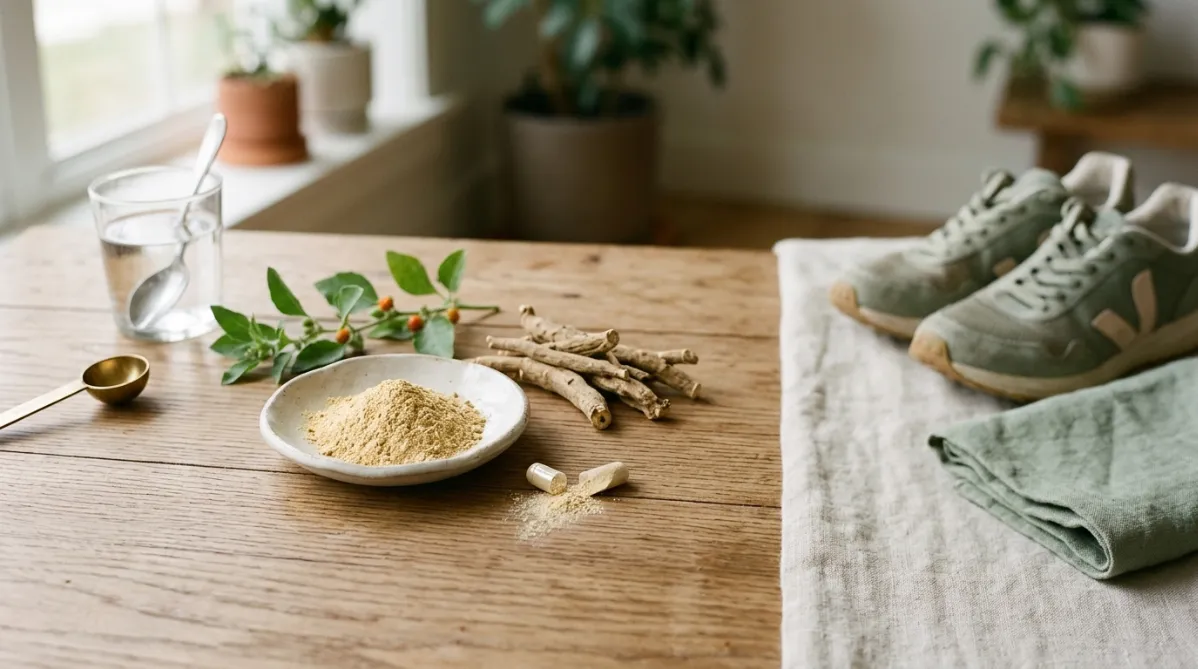
Wide landscape editorial photograph of a minimalist wooden table in soft morning light. At the center, a small ceramic dish holds a modest pile of pale golden ashwagandha root powder, with a few dried gnarled ashwagandha roots and a sprig of green leaves with tiny orange-red berries lying beside it. A single tiny capsule sits split open next to the dish, with a delicate dusting of powder spilling out, hinting at a very small dose. In the softly blurred background on the right, a pair of clean running shoes and a folded sage-green towel rest on a pale linen surface, suggesting endurance training and fitness without any people in frame. A small brass measuring spoon and a glass of water with subtle condensation add quiet detail on the left. The palette is warm and earthy: oat beige, muted sage green, terracotta, soft cream, and touches of burnt orange from the berries. Lighting is natural, diffused window light from the left, casting long gentle shadows and a subtle glow across the powder grains. Shallow depth of field with crisp focus on the powder and roots, creamy bokeh behind. Composition uses generous negative space on the right third for headline overlay, with a clean, calm, contemporary wellness-magazine aesthetic. Shot as if on a 50mm lens, fine film grain, matte finish, high-end editorial styling, tactile textures of ceramic, wood, and linen, with a restrained, thoughtful mood that hints at caution and careful consideration.
supplements

Solo 30 mg di Ashwagandha hanno aumentato il VO2max in 8 settimane. Leggi le piccole stampe

Jake the Titan · · 4 min read

L'accrocco: 30 mg possono fare ciò che solitamente si assumono 10‑20 volte di più?

Gli integratori di ashwagandha vengono solitamente venduti a dosi di centinaia di milligrammi. Un nuovo studio randomizzato, pubblicato su Phytotherapy Research (Prajapati et al.), ha testato una dose di appena 30 mg al giorno. Secondo l'abstract, è stata sufficiente a migliorare in modo significativo il VO2max rispetto al placebo in otto settimane.

Prima di riorganizzare la tua scorta di integratori, ecco cosa riporta lo studio, cosa non dice e a chi si applica.

Cosa è stato testato: non la tua tipica Ashwagandha

Il prodotto non era una semplice polvere di radice. I ricercatori hanno usato una formulazione a bassa dose di ashwagandha (LDA), indicata nell’articolo con il nome Ashwa.30. L'abstract lo descrive come un "estratto di radice ottimizzato per le componenti bioattive" standardizzato a:

  • Withanolidi: più del 15 % w/w
  • Frazione ATP‑active: più del 15 % w/w

Questo è importante. Il risultato dei 30 mg si riferisce a questo estratto standardizzato specifico, non a qualsiasi confezione etichettata "ashwagandha". Una dose di 30 mg di un prodotto poco standardizzato è qualcosa di completamente diverso, e lo studio non può parlare di quello.

Disegno dello studio

Lo studio è stato una sperimentazione di otto settimane, randomizzata, in doppio cieco e controllata con placebo su adulti sani. I partecipanti hanno assunto 30 mg/giorno di LDA oppure un placebo.

  • Endpoint primario: VO2max, stimato indirettamente con il Modified Bruce Protocol Treadmill Test (MBPTT).
  • Endpoint secondari: acido lattico, creatina fosfochinasi (CPK), Rating of Perceived Exertion (RPE), punteggi di affaticamento su scala analogica visiva (VAS) e biomarcatori di sicurezza.

Il valore di VO2max è stato stimato dal protocollo sul tapis roulant, non misurato direttamente con analisi dei gas. È un approccio pratico comune, ma meno preciso rispetto a una misurazione di laboratorio.

I risultati principali (come li riporta l'abstract)

VO2max: LDA "ha migliorato significativamente il VO2max e la frequenza cardiaca massima rispetto al placebo". L'abstract non fornisce i dati precisi sull'entità del miglioramento, quindi per conoscere gli effetti, gli intervalli di confidenza e la dimensione del campione è necessario consultare il testo completo.

Affaticamento: "I punteggi Borg RPE e di affaticamento sono migliorati nel gruppo LDA". Gli autori concludono che l'integratore "ritarda l'insorgenza della fatica".

Acido lattico: Il gruppo trattato ha mostrato livelli più bassi di acido lattico durante l'esercizio, che gli autori interpretano come un "metabolismo aerobico prolungato".

CPK: I valori sono stati "significativamente ridotti", suggerendo "una mitigazione dello stress energetico muscolare". La CPK è un marcatore spesso associato a danni muscolari, ma l'abstract non indica se ciò si traduca in un recupero più rapido o in meno infortuni. Trattatelo come risultato di biomarcatori, non come prova di beneficio di recupero.

Sicurezza: cosa riporta l'abstract

LDA è stato "ben tollerato, senza eventi avversi correlati al trattamento". I parametri ematologici, epatici, renali, metabolici e i segni vitali sono rimasti entro i range clinici normali. È rassicurante per adulti sani in un periodo di otto settimane, ma rimane una finestra temporale breve in una popolazione sana.

Conclusioni pratiche

  • Dose: 30 mg/giorno dell'estratto standardizzato specifico usato nella sperimentazione. L'abstract non ha testato altre dosi, quindi non può dirti se 30 mg superino, equivalgano o siano inferiori a 300‑600 mg. Dosi più alte sono comuni in altri studi sull'ashwagandha, ma questo studio non le ha messe a confronto.
  • Durata: otto settimane. Non aspettarti effetti immediati dopo un singolo allenamento.
  • Tempistica di assunzione: l'abstract non indica a che ora della giornata i partecipanti lo abbiano assunto; verifica il testo completo anziché indovinare.
  • A chi è destinato: le evidenze si applicano a adulti sani interessati alla forma cardiorespiratoria e a una minore sensazione di affaticamento legata all'esercizio. Gli autori lo descrivono come un potenziale "aiuto sicuro ed efficace a bassa dose per migliorare la resistenza".

Chi non dovrebbe usarlo

  • Persone con condizioni mediche o in terapia farmacologica. Lo studio ha coinvolto adulti sani, quindi i risultati non coprono chi ha patologie. Consulta un medico prima di assumere, soprattutto se sei incinta, hai problemi tiroidei, epatici, autoimmuni o assumi farmaci prescritti.

Chi cerca un salto di performance drastico

  • Senza le dimensioni dell'effetto nell'abstract, "significativo" indica solo che il risultato è statistico, non che sia spettacolare.

Chi compra un prodotto diverso di ashwagandha

  • I risultati sono legati a questo estratto standardizzato; non si possono generalizzare ad altri integratori.

Collegamenti industriali e avvertenze

L'abstract non indica le fonti di finanziamento né i conflitti di interesse. L'estratto è un prodotto a marchio proprietario (Ashwa.30) e le sperimentazioni su ingredienti brandizzati sono spesso collegate al produttore. È un motivo per controllare le dichiarazioni di conflitto nel documento completo, non una prova di bias.

Altri limiti da tenere presente:

  • È un singolo studio e l'abstract non riporta la dimensione del campione.
  • Il VO2max è stato stimato indirettamente.
  • Otto settimane su adulti sani dicono poco sull'uso a lungo termine o su atleti d'élite.
  • Non è stata effettuata una comparazione diretta con dosi più alte di ashwagandha.

Conclusione finale

Una dose di 30 mg di un estratto standardizzato di radice‑only di ashwagandha ha migliorato il VO2max stimato e i parametri di affaticamento rispetto al placebo in otto settimane, senza eventi avversi correlati al trattamento. È un risultato interessante per chi pensa che più milligrammi significhino sempre più beneficio. Restano necessarie repliche, conferme indipendenti e un'analisi dei numeri e delle dichiarazioni di conflitto nel documento completo prima di considerarlo una svolta.

Fonte: Prajapati et al., "Efficacy and Safety of Low-Dose Ashwagandha Supplementation on Exercise Endurance: A Randomized, Placebo-Controlled, Double-Blind, Clinical Trial," Phytotherapy Research. DOI: 10.1002/ptr.70178. PubMed: https://pubmed.ncbi.nlm.nih.gov/41846233/

Original study

Read the original research on pubmed.ncbi.nlm.nih.gov →

This article summarizes published research for general information. It is not medical advice.

JT

Written by

Jake the Titan

Jake the Titan writes for Dr. Gymbro: science-backed fitness, nutrition & performance.

Related Articles

A landscape editorial photograph of a trail runner's moment of rest on a misty forest trail at early morning, shot at shallow depth of field. In the foreground, a rustic ceramic bowl in muted slate blue sits on a weathered wooden fence post, filled with plump, dusty-blue fresh blueberries with a few loose berries scattered on the wood grain. A small scatter of fine, deep-purple blueberry powder dusts the post beside the bowl, with a worn wooden spoon resting nearby. Soft dew clings to the berries and catches the light.

In the soft-focus midground and background, a lone trail runner in a sage green technical jacket and charcoal shorts descends a winding dirt path through tall evergreens and ferns, captured mid-stride, slightly blurred with gentle motion. Golden sunrise light filters through the trees in warm diagonal beams, creating a hazy atmosphere with light mist hanging between the trunks. The palette is harmonious and calm: deep indigo and dusty blue from the berries, moss greens, warm amber light, and soft cream highlights.

Composition follows the rule of thirds, with the blueberry bowl anchored in the lower left third and the runner small in the upper right, leaving negative space in the misty background for headline overlay. Natural film-like grain, muted tones, subtle vignette, and a clean, contemporary magazine aesthetic similar to a health and science feature in a modern online journal. Crisp detail on the berries, creamy bokeh behind. No text, no logos, no futuristic elements.
fitness

Una settimana di mirtilli rende gli sportivi di trail più veloci. Ecco il trucco

BY POWER BRETT ·

I partecipanti hanno completato una gara di trail simulata di 22,2 km più velocemente dopo sette giorni di polvere di mirtillo rispetto a sette giorni di placebo. La frequenza cardiaca e la percezione dello sforzo non sono cambiate, ma le gambe hanno mostrato una migliore capacità di recupero in discesa. Prima di riempire il freezer con i mirtilli, è importante capire quanto piccolo fosse lo studio.

A softly lit, minimalist gym interior photographed in a modern editorial style. In the foreground, a muscular lifter in a fitted charcoal tank top is mid-set at a cable station, forearm and shoulder muscles defined, a light dusting of chalk on their hands. The frame is shot at a slight low angle with shallow depth of field, so the background gym equipment melts into creamy blur. On a matte concrete-textured bench beside them sits a clean, unbranded matte-white scoop container of white powder, a stainless steel shaker bottle, and a small analog stopwatch, arranged with careful, magazine-style composure. A few loose grains of white powder catch the light on the bench surface.

Warm golden late-afternoon sunlight pours through tall industrial windows on the left, creating long diagonal light streaks, gentle lens flare, and a subtle haze of floating chalk dust that glows in the beams. The palette is restrained and sophisticated: warm sand, soft cream, muted terracotta, deep charcoal, and a single accent of sage green from a potted plant on a shelf. Rows of neatly racked dumbbells in dark metal repeat in the mid-ground, adding rhythm and depth.

The composition follows the rule of thirds: the lifter and supplement still life occupy the right two-thirds, while the left third remains calm, with a smooth, softly blurred wall and window light, leaving generous negative space for headline text. Subtle film grain, natural color grading, and a slightly desaturated, high-end lifestyle photography look evoke a contemporary health and science journal. No text, logos, or graphics. Clean, aspirational, grounded, and tactile, with a sense of focused effort and quiet intensity.
nutrition

Beta-alanina: finalmente funziona per i sollevatori, se ti alleni così

BY DR. GYMBRO ·

La beta‑alanina ha sempre avuto una reputazione incerta nel sollevamento, ma un nuovo studio randomizzato controllato potrebbe spiegare il perché. Quando atleti allenati hanno assunto 6,4 g al giorno per quattro settimane, le loro ripetizioni totali sono aumentate del 17,3 % nei drop‑set e del 18,2 % nei bi‑set, mentre il placebo non ha mostrato miglioramenti significativi. L’intensità percepita, la motivazione e l’affettività non sono cambiate, quindi il guadagno è stato puramente fisico.

A bright, airy overhead flat-lay on a pale oak wooden table in soft morning daylight. At the center, three matching ceramic glasses in a neat row, each holding a creamy shake in a slightly different tone: one warm golden-yellow, one soft sage green-beige, one pure milky white. Beside the glasses, small shallow ceramic bowls hold the raw sources: dried yellow corn kernels, split green peas, and a small pitcher of fresh milk. A few fresh corn husks and a single ear of corn with pale green leaves are arranged diagonally across the left side of the frame, while a sprig of fresh herbs adds a touch of green. On the right, a pair of matte sage-green dumbbells and a rolled linen towel suggest light resistance exercise, placed with calm, editorial restraint. A linen napkin, a wooden scoop dusted with fine powder, and a few scattered kernels add natural texture. The color palette is warm cream, butter yellow, muted sage, and soft white, with gentle natural shadows falling to the lower right. Shallow depth of field, clean negative space at the top for headline overlay, minimalist modern magazine styling, crisp food-photography look, subtle film-like grain, wide landscape composition.
nutrition

La Proteina Vegetale che Ha Eguagliato il Latte nella Sintesi Muscolare

BY DR. GYMBRO ·

Si pensa spesso che le proteine vegetali siano inferiori al latte per favorire la crescita muscolare, ma un nuovo studio su adulti anziani dimostra che la proteina di mais non è da meno. In un trial randomizzato su 48 persone sane di circa 68 anni, 20 g di proteina di mais, una miscela pisello‑mais e la proteina del latte hanno aumentato la sintesi proteica muscolare ben oltre il placebo, senza differenze significative tra i gruppi. L’esercizio di resistenza ha amplificato la risposta in tutti i casi. Ecco dosaggio, dati numerici, potenziali benefici e avvertenze prima di cambiare il tuo shake.

A wide, softly lit editorial photograph of a modern minimalist gym corner, shot at golden hour with warm light streaming through large frosted windows. In the foreground, a matte white scoop of fine creatine powder rests on a pale oak bench beside a clear glass shaker bottle half-filled with water. A small pile of loose white powder dusts the wood surface. Just behind them, a matte black barbell loaded with charcoal bumper plates rests on a squat rack, slightly out of focus, with chalk dust floating in the sunbeams.

On the bench, a simple analog wall-style clock or a sleek minimalist wristwatch lies face up, hinting at timing without being the main focus. Next to it sits a slim open notebook with a pencil and a few hand-drawn tally marks and neat columns, suggesting tracked training data. A folded sage-green towel sits at the edge of the frame.

The color palette is calm and sophisticated: cream, warm oak, soft sage green, charcoal, and a touch of terracotta. The shallow depth of field gives creamy bokeh in the background, where the soft silhouette of a lifter in neutral athletic wear chalks their hands near the rack, rendered anonymously and without a visible face.

The composition follows a rule-of-thirds layout, with the powder and shaker in the lower left third and open negative space on the right, suitable for headline overlay. The mood is clean, focused, and quietly motivated, like a premium health and science journal feature. The lighting is natural and diffused, with gentle shadows, subtle film grain, and true-to-life textures. Shot on a 50mm lens at f/2, with crisp detail on the powder and a high-end lifestyle magazine finish.
nutrition

La creatina assunta prima dell'allenamento ha prevalso in questo test di tempistica – ma c’è una pecca

BY DR. GYMBRO ·

La questione è: importa quando si assume la creatina? Uno studio pilota randomizzato pubblicato su *Nutrients* suggerisce che una dose pre‑allenamento (0,1 g/kg) possa aumentare il carico totale sollevato nella panca e nello squat rispetto a placebo o a nessun integratore. Tuttavia, la stessa dose assunta durante o dopo l'allenamento non ha mostrato vantaggi, né sono emerse differenze in salto, umore, cognizione o indolenzimento muscolare. Lo studio è piccolo (11 uomini) e ha testato una sola dose, perciò i risultati sono da considerarsi esplorativi. Ecco i dettagli sul dosaggio, i dati e a chi conviene prestare attenzione.

This page is available in