Dr. Gymbro
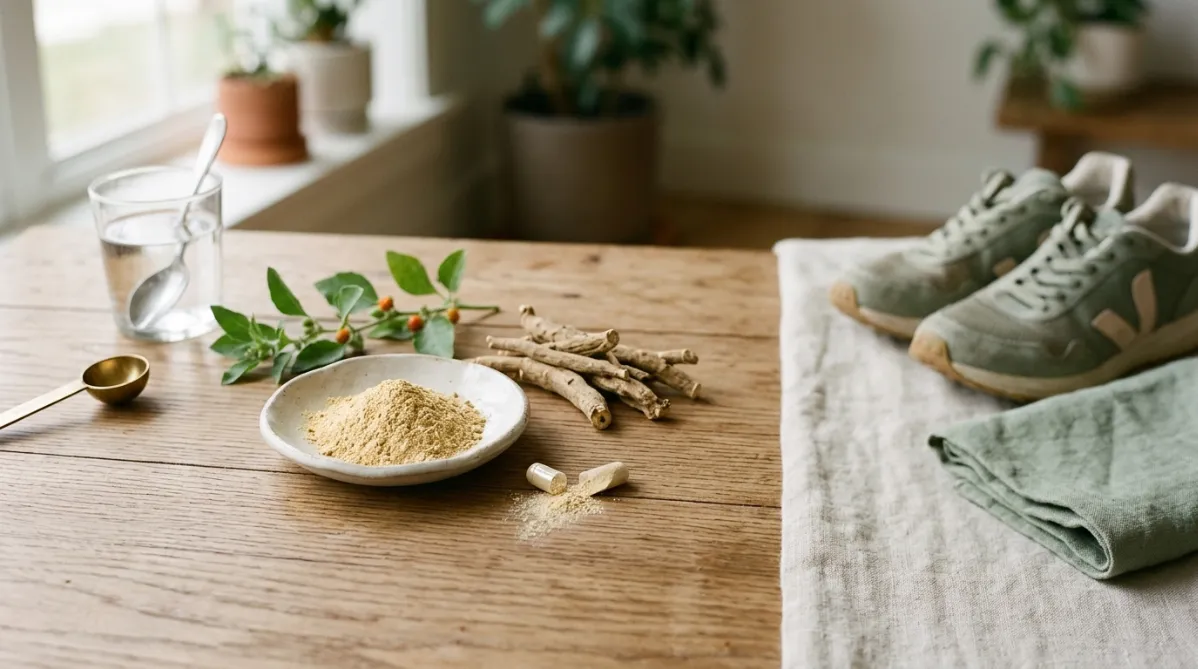
Wide landscape editorial photograph of a minimalist wooden table in soft morning light. At the center, a small ceramic dish holds a modest pile of pale golden ashwagandha root powder, with a few dried gnarled ashwagandha roots and a sprig of green leaves with tiny orange-red berries lying beside it. A single tiny capsule sits split open next to the dish, with a delicate dusting of powder spilling out, hinting at a very small dose. In the softly blurred background on the right, a pair of clean running shoes and a folded sage-green towel rest on a pale linen surface, suggesting endurance training and fitness without any people in frame. A small brass measuring spoon and a glass of water with subtle condensation add quiet detail on the left. The palette is warm and earthy: oat beige, muted sage green, terracotta, soft cream, and touches of burnt orange from the berries. Lighting is natural, diffused window light from the left, casting long gentle shadows and a subtle glow across the powder grains. Shallow depth of field with crisp focus on the powder and roots, creamy bokeh behind. Composition uses generous negative space on the right third for headline overlay, with a clean, calm, contemporary wellness-magazine aesthetic. Shot as if on a 50mm lens, fine film grain, matte finish, high-end editorial styling, tactile textures of ceramic, wood, and linen, with a restrained, thoughtful mood that hints at caution and careful consideration.
supplements

Solo 30 mg de Ashwagandha aumentaron el VO2max en 8 semanas. Lea la letra pequeña

Jake the Titan · · 4 min read

El gancho: ¿Podrían 30 mg lograr lo que la gente consume 10‑20 veces más?

Los suplementos de ashwagandha se venden habitualmente en dosis de varios cientos de miligramos. Un nuevo ensayo aleatorizado publicado en Phytotherapy Research (Prajapati et al.) evaluó una dosis de solo 30 mg al día. Según el resumen, esa cantidad bastó para mejorar de forma significativa el VO2max frente al placebo durante ocho semanas.

Antes de reorganizar tu estantería de suplementos, revisa lo que el estudio informó, lo que omitió y a quién le puede resultar relevante.

Qué se probó: no es tu ashwagandha promedio

El producto no era polvo de raíz genérico. Los investigadores emplearon un extracto de baja dosis (LDA) al que en el artículo denominan Ashwa.30. El resumen lo describe como un "extracto de raíz únicamente optimizado bioactivamente" estandarizado a:

  • Withanolides: más del 15 % p/p
  • Fracción ATP‑activa: más del 15 % p/p

Esto es importante. El resultado de 30 mg se aplica a este extracto estandarizado concreto, no a cualquier frasco que lleve la etiqueta "ashwagandha". Una dosis de 30 mg de un producto mal estandarizado sería otra cosa totalmente distinta, y el estudio no puede hablar de ello.

Diseño del estudio

Se trata de un ensayo de ocho semanas, aleatorizado, doble ciego y controlado con placebo en adultos sanos. Los participantes tomaron 30 mg/día de LDA o un placebo.

  • Desenlace primario: VO2max, estimado indirectamente con el Modified Bruce Protocol Treadmill Test (MBPTT).
  • Desenlaces secundarios: ácido láctico, creatina fosfoquinasa (CPK), Rating of Perceived Exertion (RPE), puntuaciones de fatiga en una escala visual analógica (VAS) y biomarcadores de seguridad.

El VO2max se estimuló a partir de un protocolo en cinta, no se midió directamente mediante análisis de intercambio gaseoso. Es un método práctico y frecuente, aunque menos preciso que la medición de laboratorio.

Resultados principales (según el resumen)

VO2max: LDA "mejoró significativamente el VO2max y la frecuencia cardíaca máxima comparado con el placebo". El resumen no brinda cifras de la magnitud del cambio, así que no es posible conocer tamaños de efecto, intervalos de confianza ni el número de participantes sin consultar el artículo completo.

Fatiga: "Los puntajes de Borg RPE y de fatiga mejoraron en el grupo LDA". Los autores concluyen que el suplemento "retrasó la aparición de la fatiga".

Ácido láctico: El grupo tratado mostró niveles más bajos de ácido láctico durante el ejercicio, lo que los autores interpretan como "metabolismo aeróbico prolongado".

CPK: Los niveles fueron "significativamente reducidos", lo que los autores sugieren indica "mitigación del estrés energético muscular". La CPK es un marcador asociado frecuentemente con daño muscular, pero el resumen no indica si esto se tradujo en una mejor recuperación o menos lesiones. Trátalo como un hallazgo biomarcador, no como un beneficio clínico demostrado.

Seguridad: lo que informa el resumen

LDA fue "bien tolerado, sin eventos adversos relacionados con el tratamiento". Los parámetros hematológicos, hepáticos, renales, metabólicos y los signos vitales se mantuvieron dentro de rangos clínicos normales. Eso es tranquilizador para adultos sanos durante ocho semanas, pero representa una ventana corta en una población saludable.

Conclusiones prácticas

  • Dosis: 30 mg/día del extracto estandarizado específico utilizado en el ensayo. El resumen no evalúa otras dosis, así que no puede decirte si 30 mg supera, iguala o queda por debajo de 300‑600 mg. Dosis más altas son habituales en otras investigaciones, pero este estudio no las comparó.
  • Duración: ocho semanas. No esperes efectos tras una única sesión de entrenamiento.
  • Momento de la toma: el resumen no indica a qué hora del día lo consumieron los participantes. Consulta el texto completo antes de adivinar.
  • Población a la que se dirige: adultos sanos interesados en la condición cardiorrespiratoria y en reducir la fatiga asociada al ejercicio. Los autores lo describen como una posible "ayuda segura y eficaz de baja dosis para mejorar la resistencia".
    • Personas con alguna condición médica o que tomen medicación. El ensayo incluyó solo adultos sanos, por lo que los resultados no se extrapolan a ti. Consulta a un profesional de la salud primero, sobre todo si estás embarazada, tienes problemas de tiroides, hígado, enfermedades autoinmunes o tomas fármacos con receta. Es una precaución general, no una conclusión del estudio.
    • Quienes buscan un salto de rendimiento grande y comprobado. Sin tamaños de efecto en el resumen, "significativo" indica que el resultado fue estadísticamente notable, no necesariamente dramático.
    • Quienes compran un producto de ashwagandha diferente. Los resultados están ligados a este extracto estandarizado.

Enlaces de la industria y advertencias

El resumen no menciona fuentes de financiación ni conflictos de interés. El extracto es un producto de marca propietaria (Ashwa.30), y los ensayos de suplementos de marcas suelen estar vinculados al fabricante. Esa es una razón para revisar las declaraciones de conflicto en el artículo completo, no una prueba de sesgo. Otras limitaciones a tener en cuenta:

  • Es un único ensayo y el resumen no indica el número de participantes.
  • El VO2max se estimó indirectamente.
  • Ocho semanas en adultos sanos aportan poca información sobre el uso a largo plazo o en atletas de élite.
  • No se reportó una comparación directa con dosis más altas de ashwagandha.

Conclusión

Una dosis de 30 mg de un extracto estandarizado de raíz‑sola de ashwagandha mejoró el VO2max estimado y las métricas de fatiga frente al placebo durante ocho semanas, sin eventos adversos relacionados con el tratamiento. Es un hallazgo interesante para quienes piensan que más miligramos siempre equivalen a más beneficio. Sin embargo, necesita ser replicado, confirmado de forma independiente y analizado con los números y divulgaciones completos antes de considerarse un cambio de juego.

Fuente: Prajapati et al., "Efficacy and Safety of Low-Dose Ashwagandha Supplementation on Exercise Endurance: A Randomized, Placebo‑Controlled, Double‑Blind, Clinical Trial," Phytotherapy Research. DOI: 10.1002/ptr.70178. PubMed: https://pubmed.ncbi.nlm.nih.gov/41846233/
Original study

Read the original research on pubmed.ncbi.nlm.nih.gov →

This article summarizes published research for general information. It is not medical advice.

JT

Written by

Jake the Titan

Jake the Titan writes for Dr. Gymbro: science-backed fitness, nutrition & performance.

Related Articles

A landscape editorial photograph of a trail runner's moment of rest on a misty forest trail at early morning, shot at shallow depth of field. In the foreground, a rustic ceramic bowl in muted slate blue sits on a weathered wooden fence post, filled with plump, dusty-blue fresh blueberries with a few loose berries scattered on the wood grain. A small scatter of fine, deep-purple blueberry powder dusts the post beside the bowl, with a worn wooden spoon resting nearby. Soft dew clings to the berries and catches the light.

In the soft-focus midground and background, a lone trail runner in a sage green technical jacket and charcoal shorts descends a winding dirt path through tall evergreens and ferns, captured mid-stride, slightly blurred with gentle motion. Golden sunrise light filters through the trees in warm diagonal beams, creating a hazy atmosphere with light mist hanging between the trunks. The palette is harmonious and calm: deep indigo and dusty blue from the berries, moss greens, warm amber light, and soft cream highlights.

Composition follows the rule of thirds, with the blueberry bowl anchored in the lower left third and the runner small in the upper right, leaving negative space in the misty background for headline overlay. Natural film-like grain, muted tones, subtle vignette, and a clean, contemporary magazine aesthetic similar to a health and science feature in a modern online journal. Crisp detail on the berries, creamy bokeh behind. No text, no logos, no futuristic elements.
fitness

Una Semana de Arándanos Hizo a los Corredores de Trail Más Rápidos: El Truco

BY POWER BRETT ·

Una carrera de trail simulada de 2 km se completó más rápido tras siete días de polvo de arándano que después de una semana de placebo. La frecuencia cardíaca y el esfuerzo percibido no cambiaron, pero los corredores mostraron una mejor capacidad para afrontar la bajada al día siguiente. Antes de llenar tu congelador, es importante conocer cuán limitado fue este estudio.

A softly lit, minimalist gym interior photographed in a modern editorial style. In the foreground, a muscular lifter in a fitted charcoal tank top is mid-set at a cable station, forearm and shoulder muscles defined, a light dusting of chalk on their hands. The frame is shot at a slight low angle with shallow depth of field, so the background gym equipment melts into creamy blur. On a matte concrete-textured bench beside them sits a clean, unbranded matte-white scoop container of white powder, a stainless steel shaker bottle, and a small analog stopwatch, arranged with careful, magazine-style composure. A few loose grains of white powder catch the light on the bench surface.

Warm golden late-afternoon sunlight pours through tall industrial windows on the left, creating long diagonal light streaks, gentle lens flare, and a subtle haze of floating chalk dust that glows in the beams. The palette is restrained and sophisticated: warm sand, soft cream, muted terracotta, deep charcoal, and a single accent of sage green from a potted plant on a shelf. Rows of neatly racked dumbbells in dark metal repeat in the mid-ground, adding rhythm and depth.

The composition follows the rule of thirds: the lifter and supplement still life occupy the right two-thirds, while the left third remains calm, with a smooth, softly blurred wall and window light, leaving generous negative space for headline text. Subtle film grain, natural color grading, and a slightly desaturated, high-end lifestyle photography look evoke a contemporary health and science journal. No text, logos, or graphics. Clean, aspirational, grounded, and tactile, with a sense of focused effort and quiet intensity.
nutrition

Beta‑alanina funciona para levantadores: si entrenas así

BY DR. GYMBRO ·

La beta‑alanina ha tenido una reputación ambivalente en el entrenamiento con pesas, pero un nuevo ensayo aleatorizado controlado ayuda a aclarar el panorama. Cuando levantadores experimentados tomaron 6,4 g al día durante cuatro semanas, sus repeticiones totales aumentaron un 17,3 % en series descendentes y un 18,2 % en bi‑series, mientras que el grupo placebo no mostró mejoras significativas. La percepción de esfuerzo, la motivación y el ánimo no cambiaron entre los grupos, de modo que el beneficio es puramente físico y no psicológico. Aquí tienes la dosis, el periodo de carga, a quiénes aplican los datos y quién debería seguir escéptico.

A bright, airy overhead flat-lay on a pale oak wooden table in soft morning daylight. At the center, three matching ceramic glasses in a neat row, each holding a creamy shake in a slightly different tone: one warm golden-yellow, one soft sage green-beige, one pure milky white. Beside the glasses, small shallow ceramic bowls hold the raw sources: dried yellow corn kernels, split green peas, and a small pitcher of fresh milk. A few fresh corn husks and a single ear of corn with pale green leaves are arranged diagonally across the left side of the frame, while a sprig of fresh herbs adds a touch of green. On the right, a pair of matte sage-green dumbbells and a rolled linen towel suggest light resistance exercise, placed with calm, editorial restraint. A linen napkin, a wooden scoop dusted with fine powder, and a few scattered kernels add natural texture. The color palette is warm cream, butter yellow, muted sage, and soft white, with gentle natural shadows falling to the lower right. Shallow depth of field, clean negative space at the top for headline overlay, minimalist modern magazine styling, crisp food-photography look, subtle film-like grain, wide landscape composition.
nutrition

La proteína vegetal que igualó a la leche en la síntesis muscular

BY DR. GYMBRO ·

Se suele pensar que la proteína vegetal queda rezagada frente a la leche a la hora de ganar músculo, pero un reciente ensayo en adultos mayores muestra que la proteína de maíz no se queda fuera del partido. En un estudio aleatorizado con 48 personas sanas, de alrededor de 68 años, 20 g de proteína de maíz, una combinación de guisante‑maíz y la proteína de leche aumentaron la síntesis de proteína muscular (MPS) mucho más que el placebo, sin diferencias significativas entre los grupos con proteína. El ejercicio de resistencia potenció la respuesta en todos los casos. Aquí tienes la dosis, los números, a quién podría interesar y las advertencias que debes considerar antes de cambiar tu batido.

A wide, softly lit editorial photograph of a modern minimalist gym corner, shot at golden hour with warm light streaming through large frosted windows. In the foreground, a matte white scoop of fine creatine powder rests on a pale oak bench beside a clear glass shaker bottle half-filled with water. A small pile of loose white powder dusts the wood surface. Just behind them, a matte black barbell loaded with charcoal bumper plates rests on a squat rack, slightly out of focus, with chalk dust floating in the sunbeams.

On the bench, a simple analog wall-style clock or a sleek minimalist wristwatch lies face up, hinting at timing without being the main focus. Next to it sits a slim open notebook with a pencil and a few hand-drawn tally marks and neat columns, suggesting tracked training data. A folded sage-green towel sits at the edge of the frame.

The color palette is calm and sophisticated: cream, warm oak, soft sage green, charcoal, and a touch of terracotta. The shallow depth of field gives creamy bokeh in the background, where the soft silhouette of a lifter in neutral athletic wear chalks their hands near the rack, rendered anonymously and without a visible face.

The composition follows a rule-of-thirds layout, with the powder and shaker in the lower left third and open negative space on the right, suitable for headline overlay. The mood is clean, focused, and quietly motivated, like a premium health and science journal feature. The lighting is natural and diffused, with gentle shadows, subtle film grain, and true-to-life textures. Shot on a 50mm lens at f/2, with crisp detail on the powder and a high-end lifestyle magazine finish.
nutrition

La Creatina Tomada Antes del Entrenamiento Superó la Prueba de Temporización—Pero Hay una Trampa

BY DR. GYMBRO ·

¿Importa el momento en que tomas creatina? Un pequeño estudio piloto aleatorizado publicado en *Nutrients* sugiere que ingerirla justo antes de entrenar podría mejorar la carga total levantada en press de banca y sentadilla trasera. No se observó ninguna diferencia en salto, estado de ánimo, cognición o dolor muscular. Sin embargo, el ensayo contó con solo 11 hombres y una única dosis, por lo que los autores lo describen como exploratorio. Aquí tienes la dosis exacta, los datos y quién debería ser cauteloso.

This page is available in