Dr. Gymbro
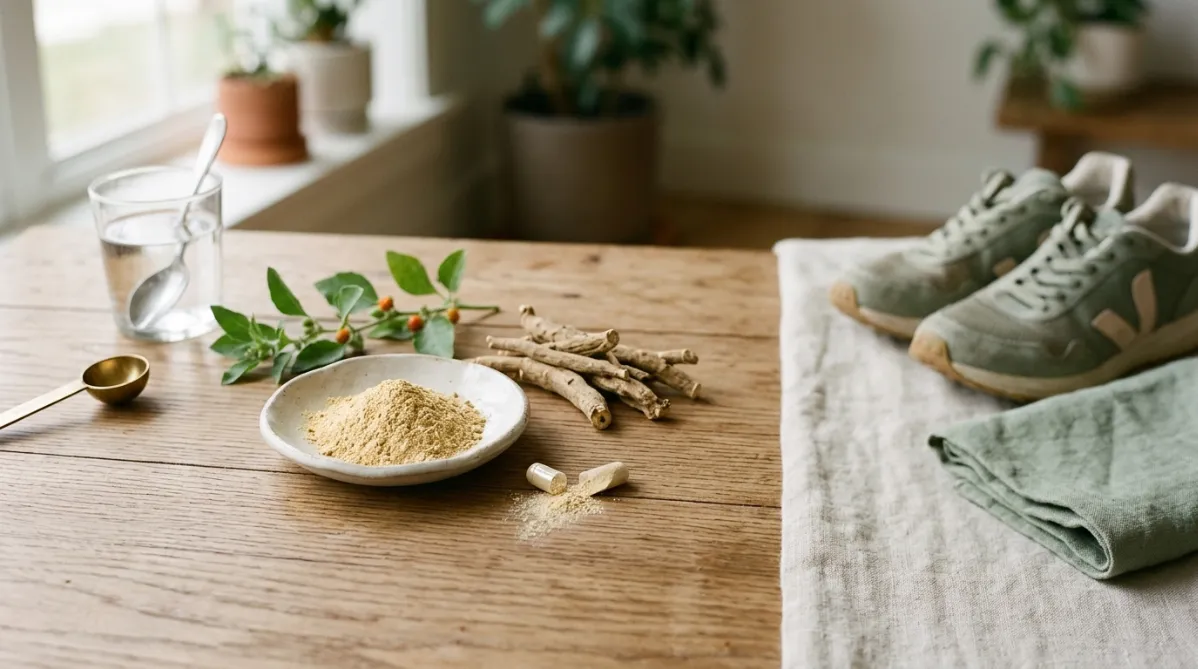
Wide landscape editorial photograph of a minimalist wooden table in soft morning light. At the center, a small ceramic dish holds a modest pile of pale golden ashwagandha root powder, with a few dried gnarled ashwagandha roots and a sprig of green leaves with tiny orange-red berries lying beside it. A single tiny capsule sits split open next to the dish, with a delicate dusting of powder spilling out, hinting at a very small dose. In the softly blurred background on the right, a pair of clean running shoes and a folded sage-green towel rest on a pale linen surface, suggesting endurance training and fitness without any people in frame. A small brass measuring spoon and a glass of water with subtle condensation add quiet detail on the left. The palette is warm and earthy: oat beige, muted sage green, terracotta, soft cream, and touches of burnt orange from the berries. Lighting is natural, diffused window light from the left, casting long gentle shadows and a subtle glow across the powder grains. Shallow depth of field with crisp focus on the powder and roots, creamy bokeh behind. Composition uses generous negative space on the right third for headline overlay, with a clean, calm, contemporary wellness-magazine aesthetic. Shot as if on a 50mm lens, fine film grain, matte finish, high-end editorial styling, tactile textures of ceramic, wood, and linen, with a restrained, thoughtful mood that hints at caution and careful consideration.
supplements

Apenas 30 mg de Ashwagandha aumentam o VO2máx em 8 semanas – veja os detalhes

Jake the Titan · · 4 min read

O Gancho: será que 30 mg fazem o que a gente normalmente toma 10‑20 vezes mais?

Os suplementos de ashwagandha costumam ser vendidos em doses de centenas de miligramas. Um novo ensaio randomizado publicado na Phytotherapy Research (Prajapati et al.) avaliou uma dose de apenas 30 mg por dia. Segundo o resumo, essa quantidade foi suficiente para melhorar significativamente o VO2máx em relação ao placebo ao longo de oito semanas.

Antes de reorganizar a prateleira dos suplementos, veja o que o estudo realmente relata, o que ele deixa de fora e a quem os resultados se aplicam.

O que foi testado: não é a sua ashwagandha comum

O produto testado não era um pó genérico de raiz. Os pesquisadores usaram uma formulação de baixa dose (LDA), rotulada no artigo como Ashwa.30. O resumo a descreve como um "extrato de raiz‑only otimizado para bioatividade", padronizado para:

  • Withanolides: mais de 15 % w/w
  • Fração "ATP‑ativa": mais de 15 % w/w

Isso importa. O efeito observado com 30 mg só se aplica a esse extrato padronizado específico, e não a qualquer frasco rotulado simplesmente "ashwagandha". Uma dose de 30 mg de um produto mal padronizado poderia ter resultados diferentes, e o estudo não pode falar sobre isso.

Desenho do estudo

Trata‑se de um ensaio randomizado, duplo‑cego e controlado por placebo, com duração de oito semanas, realizado em adultos saudáveis. Os participantes receberam ou 30 mg/dia de LDA ou um placebo.

  • Desfecho primário: VO2máx, estimado indiretamente pelo Modified Bruce Protocol Treadmill Test (MBPTT).
  • Desfechos secundários: ácido láctico, creatina quinase (CPK), Rating of Perceived Exertion (RPE), escores de fadiga em escala visual analógica (VAS) e biomarcadores de segurança.

O valor de VO2máx foi estimado a partir de um protocolo de esteira, não medido diretamente por análise de troca gasosa. Essa prática é comum por questões de praticidade, mas é menos precisa que a medição em laboratório.

Resultados principais (conforme o resumo)

VO2máx: a LDA "melhorou significativamente o VO2máx e a frequência cardíaca máxima em comparação ao placebo". O resumo não apresenta os valores absolutos nem a magnitude do efeito, sendo necessário consultar o artigo completo para esses detalhes.

Fadiga: "Os escores de Borg RPE e fadiga melhoraram no grupo LDA". Os autores concluem que o suplemento "adiou o início da fadiga".

Ácido láctico: o grupo tratado apresentou níveis mais baixos de ácido láctico durante o exercício, o que foi interpretado como "metabolismo aeróbico prolongado".

CPK: os níveis foram "significativamente reduzidos", sugerindo "mitigação do estresse energético muscular". A CPK indica esforço muscular, mas o resumo não informa se isso se traduziu em recuperação mais rápida ou menor risco de lesões. Portanto, trata‑se de um achado bioquímico, não de prova de benefício funcional.

Segurança: o que o resumo relata

A LDA foi "bem tolerada, sem eventos adversos relacionados ao tratamento". Parâmetros hematológicos, hepáticos, renais, metabólicos e sinais vitais permaneceram dentro dos limites clínicos normais. Isso é tranquilizador para adultos saudáveis por oito semanas, mas ainda representa um período curto e uma população limitada.

Dicas práticas

  • Dose: 30 mg/dia do extrato padronizado específico usado no estudo. O resumo não testou outras doses, portanto não há como afirmar se 30 mg supera, iguala ou fica aquém de 300‑600 mg. Doses mais altas são comuns em outras pesquisas, porém não foram comparadas aqui.
  • Duração: oito semanas. Não espere efeito imediato após um único treino.
  • Horário: o resumo não informa em que momento do dia os participantes tomaram o suplemento. Consulte o texto completo para esse detalhe.
  • Para quem: adultos saudáveis que buscam melhorar a aptidão cardiorrespiratória e reduzir a fadiga relacionada ao exercício. Os autores descrevem o suplemento como um potencial "auxílio seguro e eficaz em baixa dose para aumento de endurance".
    • Pessoas com condições médicas ou em uso de medicação: o estudo incluiu apenas adultos saudáveis; os resultados não se aplicam a quem tem doenças ou faz uso de fármacos. Consulte um profissional antes de usar, especialmente se estiver grávida, com problemas tireoidianos, hepáticos, auto‑imunes ou em uso de medicamentos prescritos.
    • Quem procura um salto de performance dramático: sem os tamanhos de efeito, "significativo" indica apenas relevância estatística, não magnitude extraordinária.
    • Quem compra outro produto de ashwagandha: os resultados são específicos ao extrato padronizado testado.

O resumo não menciona fontes de financiamento nem conflitos de interesse. O extrato é um produto proprietário (Ashwa.30), e ensaios com ingredientes marcados costumam estar ligados ao fabricante. Isso justifica a verificação das declarações completas de conflito, mas não prova viés por si só. Outros pontos a considerar:

  • É um único ensaio, e o resumo não informa o tamanho da amostra.
  • VO2máx foi estimado indiretamente.
  • Oito semanas em adultos saudáveis dizem pouco sobre uso a longo prazo ou em atletas de alto nível.
  • Não houve comparação direta com doses maiores de ashwagandha.

Conclusão

Uma dose de 30 mg de um extrato padronizado de raiz‑only de ashwagandha aumentou o VO2máx estimado e melhorou marcadores de fadiga em comparação ao placebo ao longo de oito semanas, sem eventos adversos relacionados ao tratamento. O achado é interessante para quem pensa que mais miligramas sempre significam mais benefício, mas ainda precisa ser replicado, confirmado por estudos independentes e analisado em detalhes (tamanhos de efeito, divulgação de conflitos, etc.) antes de ser considerado um divisor de águas.

Fonte: Prajapati et al., "Efficacy and Safety of Low‑Dose Ashwagandha Supplementation on Exercise Endurance: A Randomized, Placebo‑Controlled, Double‑Blind, Clinical Trial," Phytotherapy Research. DOI: 10.1002/ptr.70178. PubMed: https://pubmed.ncbi.nlm.nih.gov/41846233/
Original study

Read the original research on pubmed.ncbi.nlm.nih.gov →

This article summarizes published research for general information. It is not medical advice.

JT

Written by

Jake the Titan

Jake the Titan writes for Dr. Gymbro: science-backed fitness, nutrition & performance.

Related Articles

A landscape editorial photograph of a trail runner's moment of rest on a misty forest trail at early morning, shot at shallow depth of field. In the foreground, a rustic ceramic bowl in muted slate blue sits on a weathered wooden fence post, filled with plump, dusty-blue fresh blueberries with a few loose berries scattered on the wood grain. A small scatter of fine, deep-purple blueberry powder dusts the post beside the bowl, with a worn wooden spoon resting nearby. Soft dew clings to the berries and catches the light.

In the soft-focus midground and background, a lone trail runner in a sage green technical jacket and charcoal shorts descends a winding dirt path through tall evergreens and ferns, captured mid-stride, slightly blurred with gentle motion. Golden sunrise light filters through the trees in warm diagonal beams, creating a hazy atmosphere with light mist hanging between the trunks. The palette is harmonious and calm: deep indigo and dusty blue from the berries, moss greens, warm amber light, and soft cream highlights.

Composition follows the rule of thirds, with the blueberry bowl anchored in the lower left third and the runner small in the upper right, leaving negative space in the misty background for headline overlay. Natural film-like grain, muted tones, subtle vignette, and a clean, contemporary magazine aesthetic similar to a health and science feature in a modern online journal. Crisp detail on the berries, creamy bokeh behind. No text, no logos, no futuristic elements.
fitness

Uma Semana de Mirtilos Deixou Corredores de Trilha Mais Rápidos, Mas Há uma Pegadinha

BY POWER BRETT ·

Uma corrida simulada de 2 km em trilha foi mais rápida após sete dias de consumo de pó de mirtilo, comparada a sete dias de placebo. A frequência cardíaca e a percepção de esforço durante a prova não apresentaram diferenças. As pernas também parecem ter lidado melhor com o esforço da descida no dia seguinte. Antes de congelar os mirtilos, é importante saber o quão pequeno foi este estudo.

A softly lit, minimalist gym interior photographed in a modern editorial style. In the foreground, a muscular lifter in a fitted charcoal tank top is mid-set at a cable station, forearm and shoulder muscles defined, a light dusting of chalk on their hands. The frame is shot at a slight low angle with shallow depth of field, so the background gym equipment melts into creamy blur. On a matte concrete-textured bench beside them sits a clean, unbranded matte-white scoop container of white powder, a stainless steel shaker bottle, and a small analog stopwatch, arranged with careful, magazine-style composure. A few loose grains of white powder catch the light on the bench surface.

Warm golden late-afternoon sunlight pours through tall industrial windows on the left, creating long diagonal light streaks, gentle lens flare, and a subtle haze of floating chalk dust that glows in the beams. The palette is restrained and sophisticated: warm sand, soft cream, muted terracotta, deep charcoal, and a single accent of sage green from a potted plant on a shelf. Rows of neatly racked dumbbells in dark metal repeat in the mid-ground, adding rhythm and depth.

The composition follows the rule of thirds: the lifter and supplement still life occupy the right two-thirds, while the left third remains calm, with a smooth, softly blurred wall and window light, leaving generous negative space for headline text. Subtle film grain, natural color grading, and a slightly desaturated, high-end lifestyle photography look evoke a contemporary health and science journal. No text, logos, or graphics. Clean, aspirational, grounded, and tactile, with a sense of focused effort and quiet intensity.
nutrition

Beta‑Alanina Finalmente Funciona para Levantadores — Se Você Treinar Assim

BY DR. GYMBRO ·

A beta‑alanina tem um histórico nebuloso quando o assunto é musculação, mas um novo ensaio clínico randomizado pode explicar o porquê. Quando levantadores treinados tomaram 6,4 g por dia durante quatro semanas, o total de repetições aumentou 17,3 % em drop sets e 18,2 % em bi‑sets, enquanto o grupo placebo não apresentou ganhos significativos. O esforço percebido, a motivação e o afeto não diferiram entre os grupos, indicando que o ganho foi físico e não psicológico. Aqui estão a dose, o período de carga, a quem os dados se aplicam e quem ainda deve manter o ceticismo.

A bright, airy overhead flat-lay on a pale oak wooden table in soft morning daylight. At the center, three matching ceramic glasses in a neat row, each holding a creamy shake in a slightly different tone: one warm golden-yellow, one soft sage green-beige, one pure milky white. Beside the glasses, small shallow ceramic bowls hold the raw sources: dried yellow corn kernels, split green peas, and a small pitcher of fresh milk. A few fresh corn husks and a single ear of corn with pale green leaves are arranged diagonally across the left side of the frame, while a sprig of fresh herbs adds a touch of green. On the right, a pair of matte sage-green dumbbells and a rolled linen towel suggest light resistance exercise, placed with calm, editorial restraint. A linen napkin, a wooden scoop dusted with fine powder, and a few scattered kernels add natural texture. The color palette is warm cream, butter yellow, muted sage, and soft white, with gentle natural shadows falling to the lower right. Shallow depth of field, clean negative space at the top for headline overlay, minimalist modern magazine styling, crisp food-photography look, subtle film-like grain, wide landscape composition.
nutrition

A proteína vegetal que acabou de igualar o leite na síntese muscular

BY DR. GYMBRO ·

A proteína vegetal costuma ser considerada inferior ao leite na construção muscular, mas um novo estudo com idosos mostrou que a proteína de milho não recebeu esse alerta. Em um ensaio randomizado com 48 adultos saudáveis, em média com 68 anos, 20 g de proteína de milho, uma mistura de ervilha e milho e a proteína do leite aumentaram a síntese de proteína muscular muito além do placebo, sem diferenças entre os grupos de proteína. O exercício de resistência potencializou a resposta em todos os grupos. A seguir, a dose, os números, quem pode se beneficiar e as ressalvas antes de trocar seu shake.

A wide, softly lit editorial photograph of a modern minimalist gym corner, shot at golden hour with warm light streaming through large frosted windows. In the foreground, a matte white scoop of fine creatine powder rests on a pale oak bench beside a clear glass shaker bottle half-filled with water. A small pile of loose white powder dusts the wood surface. Just behind them, a matte black barbell loaded with charcoal bumper plates rests on a squat rack, slightly out of focus, with chalk dust floating in the sunbeams.

On the bench, a simple analog wall-style clock or a sleek minimalist wristwatch lies face up, hinting at timing without being the main focus. Next to it sits a slim open notebook with a pencil and a few hand-drawn tally marks and neat columns, suggesting tracked training data. A folded sage-green towel sits at the edge of the frame.

The color palette is calm and sophisticated: cream, warm oak, soft sage green, charcoal, and a touch of terracotta. The shallow depth of field gives creamy bokeh in the background, where the soft silhouette of a lifter in neutral athletic wear chalks their hands near the rack, rendered anonymously and without a visible face.

The composition follows a rule-of-thirds layout, with the powder and shaker in the lower left third and open negative space on the right, suitable for headline overlay. The mood is clean, focused, and quietly motivated, like a premium health and science journal feature. The lighting is natural and diffused, with gentle shadows, subtle film grain, and true-to-life textures. Shot on a 50mm lens at f/2, with crisp detail on the powder and a high-end lifestyle magazine finish.
nutrition

Creatina antes do treino venceu este teste de timing — mas há um detalhe

BY DR. GYMBRO ·

Importa quando você toma creatina? Um estudo piloto randomizado cruzado publicado em *Nutrients* sugere que a janela pré‑treino pode conferir vantagem: 0,1 g/kg de creatina monohidratada ingerida antes do treino gerou maior carga total levantada no supino e no agachamento em comparação ao placebo ou à ausência de suplemento. Tomá‑la durante ou após o treino não trouxe o mesmo benefício, e não houve diferenças em salto, humor, cognição ou dor muscular. O estudo, porém, contou com apenas 11 homens e testou uma dose única, sendo considerado exploratório pelos autores. Veja a dose exata, o que os dados revelam e quem deve ter cautela.

This page is available in