Dr. Gymbro
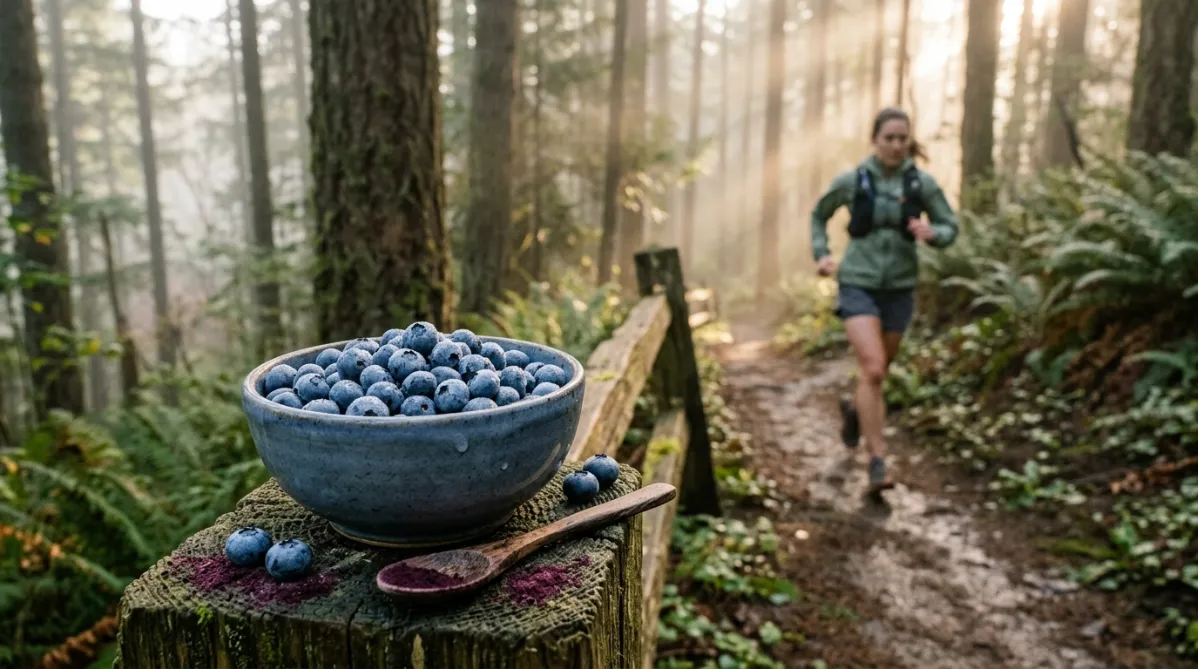
A landscape editorial photograph of a trail runner's moment of rest on a misty forest trail at early morning, shot at shallow depth of field. In the foreground, a rustic ceramic bowl in muted slate blue sits on a weathered wooden fence post, filled with plump, dusty-blue fresh blueberries with a few loose berries scattered on the wood grain. A small scatter of fine, deep-purple blueberry powder dusts the post beside the bowl, with a worn wooden spoon resting nearby. Soft dew clings to the berries and catches the light.

In the soft-focus midground and background, a lone trail runner in a sage green technical jacket and charcoal shorts descends a winding dirt path through tall evergreens and ferns, captured mid-stride, slightly blurred with gentle motion. Golden sunrise light filters through the trees in warm diagonal beams, creating a hazy atmosphere with light mist hanging between the trunks. The palette is harmonious and calm: deep indigo and dusty blue from the berries, moss greens, warm amber light, and soft cream highlights.

Composition follows the rule of thirds, with the blueberry bowl anchored in the lower left third and the runner small in the upper right, leaving negative space in the misty background for headline overlay. Natural film-like grain, muted tones, subtle vignette, and a clean, contemporary magazine aesthetic similar to a health and science feature in a modern online journal. Crisp detail on the berries, creamy bokeh behind. No text, no logos, no futuristic elements.
Fitness

Una settimana di mirtilli rende gli sportivi di trail più veloci. Ecco il trucco

Power Brett · · 5 min read

Una settimana di mirtilli rende gli sportivi di trail più veloci. Ecco il trucco

Estratto

I partecipanti hanno completato una gara di trail simulata di 22,2 km più rapidamente dopo sette giorni di integrazione con polvere di mirtillo rispetto a sette giorni di placebo. La frequenza cardiaca e la percezione dello sforzo non sono variate, mentre le gambe hanno gestito meglio il carico della discesa il giorno successivo. Prima di accumulare mirtilli nel freezer, è fondamentale valutare le dimensioni e i limiti di questo studio.

Contenuto

Uno studio crossover di piccola scala ha mostrato che i corridori hanno terminato una gara di trail simulata di 22,2 km più velocemente dopo sette giorni di polvere di mirtillo highbush liofilizzata (BLU) rispetto a sette giorni di polvere placebo (PLA). La frequenza cardiaca e la percezione dello sforzo non sono cambiate, ma le gambe hanno mostrato una migliore capacità di gestire la penalità della discesa il giorno successivo. Prima di riempire il freezer, è importante conoscere le limitazioni del campione.

I risultati provengono da uno studio randomizzato controllato di Giles e colleghi, pubblicato nell'International Journal of Sport Nutrition and Exercise Metabolism (PubMed; DOI).

Cosa hanno testato i ricercatori

Il trail running, soprattutto con tratti in discesa, può provocare danni muscolari, stress ossidativo e infiammazione, fattori strettamente legati alla fatica. I mirtilli, ricchi di antiossidanti, sono stati scelti per verificare se un breve periodo di integrazione potesse attenuare questi danni e migliorare le prestazioni.

Nove corridori esperti hanno completato la gara dopo 7 giorni di integrazione con polvere di mirtillo highbush liofilizzata (BLU) e, in un periodo separato, dopo 7 giorni di polvere placebo (PLA). Ogni atleta ha sperimentato entrambe le condizioni, rendendo possibile un design crossover in cui ciascuno funge da proprio controllo – una soluzione ideale quando il campione è molto piccolo.

I ricercatori hanno misurato una serie ampia di parametri prima della gara, subito dopo e 24 ore dopo:

  • Sintomi e indolenzimento muscolare
  • Analisi dell'onda di polso e velocità dell'onda di polso (marcatori vascolari)
  • Indice di forza reattiva e altezza del salto in perdita (funzione neuromuscolare)
  • Funzione polmonare
  • Cortisolo salivare e immunoglobulina A
  • Frazione di ossido nitrico esalato, pre‑ e post‑gara

Durante la gara sono state monitorate la frequenza cardiaca e le valutazioni di sforzo percepito per gambe e polmoni.

Il risultato principale: più veloce senza sforzo extra

Il tempo di gara è stato significativamente più veloce con il supplemento di mirtilli (p = 0,003). La frequenza cardiaca e le valutazioni di sforzo percepito non differivano tra le due condizioni. In pratica, i corridori hanno corso più rapidamente senza avvertire una maggiore difficoltà né un più alto carico cardiaco, almeno secondo le misure adottate.

L'abstract non specifica di quanti minuti sia stato ridotto il tempo, quindi non si può dare per scontato che la differenza sia enorme. Il valore p indica solo che la differenza osservata è improbabile sia dovuta al caso nel campione testato; non quantifica l'entità dell'effetto.

Gli indizi per il recupero

Alcuni risultati secondari hanno favorito i mirtilli:

  • Frequenza cardiaca a riposo in posizione supina più bassa con BLU (p = 0,031).
  • Sensazione di affaticamento più bassa con BLU (p = 0,005).
  • Rapporto FEV1/FVC (indice di funzione polmonare) più alto con BLU (p = 0,023).
  • Altezza del salto in perdita diminuita 24 ore dopo la gara in PLA (p = 0,022), mentre è rimasta stabile in BLU.

Il risultato sul salto in perdita è il più rilevante per la domanda sul recupero in discesa, poiché suggerisce che la capacità esplosiva e di “stretch‑shortening” delle gambe si è mantenuta meglio il giorno successivo quando i corridori avevano assunto i mirtilli. Gli autori concludono che l'integrazione ha migliorato le prestazioni "senza aumentare lo stress fisiologico o percettivo".

Indicazioni pratiche

Dosaggio: L'abstract non indica la quantità in grammi, quindi è necessario consultare l'articolo completo prima di replicare il protocollo. La forma usata era polvere di mirtillo highbush liofilizzata, non frutta fresca né estratto.

Tempistica: I corridori hanno assunto il supplemento per 7 giorni consecutivi prima della gara. Il recupero è stato valutato subito dopo la gara e a 24 ore. Si tratta quindi di un approccio di “caricamento” a breve termine, non di una singola dose pre‑gara.

Chi può trarne beneficio: Corridori esperti che si preparano a gare con molti dislivelli o discese, dove il danno muscolare e la fatica del giorno successivo sono fattori decisivi. È la popolazione studiata.

Chi dovrebbe essere cauto o evitarlo: L'abstract non riporta esclusioni di sicurezza, perciò il consiglio resta generico. Chi ha allergie ai frutti, problemi gastrointestinali sensibili o condizioni mediche che richiedono una gestione specifica di carboidrati o di dieta dovrebbe consultare un medico o un dietista. Principianti e non corridori esulano dallo scopo di questo studio.

Il retroscena: solo nove corridori

Questa è la parte da tenere a mente prima di entusiasmarci. Nove partecipanti costituiscono un campione molto piccolo. Gli studi di piccola scala tendono a sovrastimare gli effetti e i risultati potrebbero non generalizzarsi a donne, corridori più anziani, neofiti o gare più lunghe. Inoltre, la gara era simulata, non una competizione reale. L'abstract non evidenzia differenze in marcatori come il cortisolo salivare o l'immunoglobulina A, quindi l'affermazione "nessun stress aggiuntivo" significa solo che questi parametri non hanno mostrato differenze, non che i mirtilli abbiano ridotto lo stress in assoluto. Sono stati testati molti outcome contemporaneamente e l'abstract non specifica come sia stata gestita la correzione statistica.

Conclusione

Si tratta di uno studio promettente, utile per generare ipotesi, non di una raccomandazione obbligatoria. Una settimana di integrazione con polvere di mirtillo highbush liofilizzata è stata associata a una migliore performance in una gara di trail, a una percezione di minore fatica e a una migliore conservazione del salto il giorno successivo, senza costi percepiti in termini di sforzo. Se sei un corridore sano e ti piacciono i mirtilli, è un esperimento a basso rischio per la tua prossima gara collinare. Consideralo come un test personale e attendi conferme da studi più ampi prima di definirlo un “trucco” definitivo per la performance.

Fonte: Giles et al., Seven Days of Highbush Blueberry Supplementation Improves Trail Running Performance in Experienced Runners Without Elevating Physiological or Perceptual Stress Markers, Int J Sport Nutr Exerc Metab. PubMed 42521198.
Original study

Read the original research on pubmed.ncbi.nlm.nih.gov →

This article summarizes published research for general information. It is not medical advice.

PB

Written by

Power Brett

Power Brett writes for Dr. Gymbro: science-backed fitness, nutrition & performance.

Related Articles

A wide landscape editorial photograph of a clean, sunlit kitchen counter in soft morning light, shot from a slightly elevated three-quarter angle with shallow depth of field. In the foreground, a small matte ceramic dish holds a handful of pale cream-colored supplement capsules, with a few spilled casually onto a pale oak surface. Beside them sits an unlabeled amber glass bottle with its cap off. A folded gray linen napkin and a glass of water with delicate condensation add a calm, everyday feel.

In the softly blurred midground, a pair of well-worn running shoes in muted sage green rests beside a rolled yoga mat in dusty terracotta. A small notebook lies open with a pencil resting across it, its pages showing faint hand-drawn bar charts that are nearly flat, with one or two slightly taller bars. The charts are suggestive rather than legible.

The background is a bright window with sheer white curtains, casting long, gentle shadows across the counter. A potted eucalyptus sprig in a simple white vase adds a touch of organic green.

The palette is restrained and modern: warm creams, soft sage, terracotta, muted oatmeal, and pale wood tones, with subtle highlights on the glass and ceramic. The mood is thoughtful, skeptical, and quietly informative, like a contemporary health and science magazine feature. Natural film-like grain, soft contrast, and generous negative space on the right third of the frame leave room for headline text. There are no people, no logos, no text, and no futuristic elements, only a minimalist, trendy, lifestyle-journal aesthetic.
fitness

2 g di Carnosina al giorno per 12 settimane: lo studio su 299 persone è per lo più inutile

BY IRON MARCUS ·

Le capsule di carnosina sono pubblicizzate come stimolatori della resistenza muscolare. Un nuovo studio randomizzato su 299 partecipanti, controllato con placebo, ha messo alla prova questa affermazione, rilevando per lo più risultati nulli. Sono emersi però un paio di segnali in sottogruppi, da considerare con cautela e senza esagerarne l'importanza.

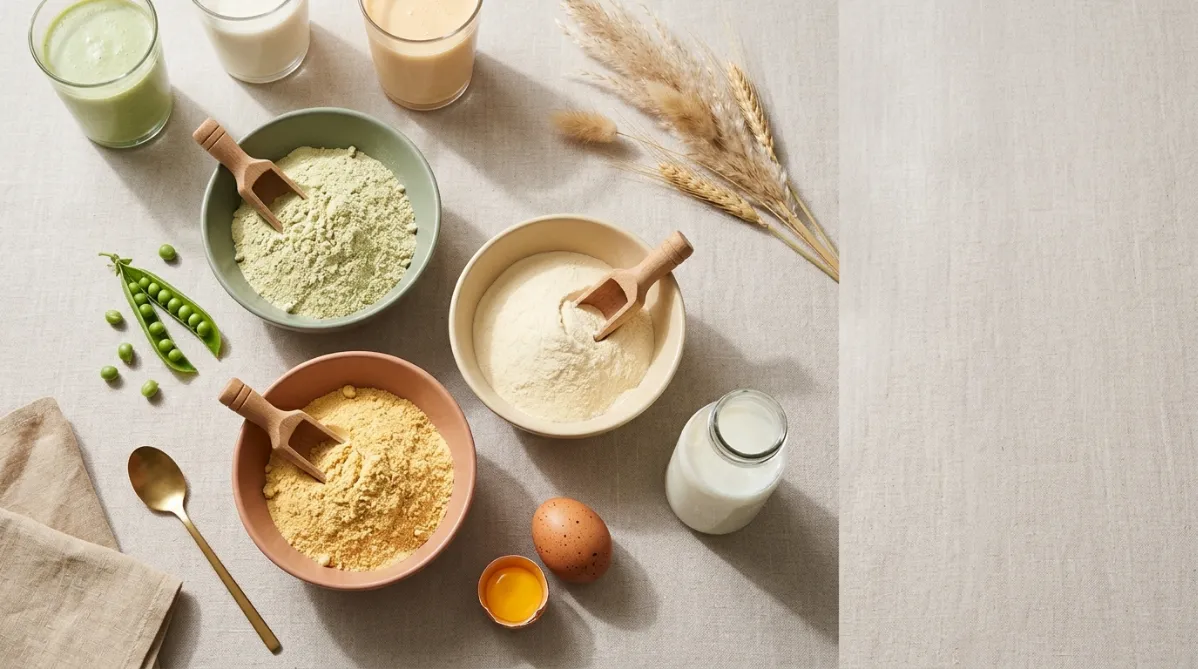
A overhead flat-lay photograph in a modern editorial style, shot on a pale oatmeal-colored linen surface with soft, diffused natural window light coming from the upper left, casting gentle, elongated shadows. Three ceramic bowls in matte, muted tones sit in a loose, balanced triangle composition: one in dusty sage green holding fine pale-green pea protein powder, one in warm cream holding silky ivory whey powder, and one in soft terracotta holding golden-yellow egg protein powder. Each bowl has a small wooden scoop resting against its rim, with a few powder specks scattered naturally across the linen.

Around the bowls, subtle ingredient cues add storytelling without clutter: a handful of fresh green peas in their open pod beside the sage bowl, a small glass bottle of milk with a faint condensation sheen near the cream bowl, and two brown speckled eggs, one whole and one cracked open to reveal a bright yolk, near the terracotta bowl. A sprig of dried wheat or pampas grass enters the frame from the top right corner for texture and height.

Three glass tumblers of smoothie-like shakes in slightly different hues, soft green, creamy white, and pale apricot, stand along the upper edge of the frame, slightly out of focus, creating depth and a gentle rhythm. A thin brass spoon and a folded sand-colored napkin add a refined touch in the lower left.

The palette is warm and earthy: sage, cream, terracotta, butter yellow, and soft beige, with tiny accents of brass. Negative space is left on the right third of the composition for possible title overlay, keeping the layout airy and uncluttered. The overall mood is calm, thoughtful, and approachable, like a contemporary wellness magazine or minimalist food journal, with crisp focus on the bowls, shallow depth of field toward the edges, subtle film-like grain, and a clean, sophisticated, slightly matte finish.
fitness

Whey vs Pisello vs Uovo: 51 studi confrontano le proteine per la sintesi muscolare post‑allenamento

BY COACH RYAN ·

Ti aspetti una sfida tra proteine del siero, pisello e uovo per decretare un vincitore netto. In realtà non è così, e la ragione è più intrigante di una semplice graduatoria. Una revisione sistematica ha raccolto 51 trial basati su traccianti per valutare la sintesi proteica muscolare post‑allenamento. Solo il siero di latte standard ha mostrato un effetto statisticamente significativo, ma ciò dipende più dalla precisione dei dati che da una reale superiorità biologica.

Wide landscape editorial photograph of a minimalist wooden table in soft morning light. At the center, a small ceramic dish holds a modest pile of pale golden ashwagandha root powder, with a few dried gnarled ashwagandha roots and a sprig of green leaves with tiny orange-red berries lying beside it. A single tiny capsule sits split open next to the dish, with a delicate dusting of powder spilling out, hinting at a very small dose. In the softly blurred background on the right, a pair of clean running shoes and a folded sage-green towel rest on a pale linen surface, suggesting endurance training and fitness without any people in frame. A small brass measuring spoon and a glass of water with subtle condensation add quiet detail on the left. The palette is warm and earthy: oat beige, muted sage green, terracotta, soft cream, and touches of burnt orange from the berries. Lighting is natural, diffused window light from the left, casting long gentle shadows and a subtle glow across the powder grains. Shallow depth of field with crisp focus on the powder and roots, creamy bokeh behind. Composition uses generous negative space on the right third for headline overlay, with a clean, calm, contemporary wellness-magazine aesthetic. Shot as if on a 50mm lens, fine film grain, matte finish, high-end editorial styling, tactile textures of ceramic, wood, and linen, with a restrained, thoughtful mood that hints at caution and careful consideration.
supplements

Solo 30 mg di Ashwagandha hanno aumentato il VO2max in 8 settimane. Leggi le piccole stampe

BY JAKE THE TITAN ·

Gli integratori di ashwagandha vengono solitamente venduti a dosi di centinaia di milligrammi. Uno studio ha testato una dose di appena 30 mg al giorno. Secondo l'abstract, è stata sufficiente a migliorare in modo significativo il VO2max rispetto al placebo in otto settimane. Questo risultato sorprende perché la maggior parte dei prodotti commerciali contiene dosi molto più alte. Tuttavia, è importante considerare le specifiche del prodotto testato.

A softly lit, minimalist gym interior photographed in a modern editorial style. In the foreground, a muscular lifter in a fitted charcoal tank top is mid-set at a cable station, forearm and shoulder muscles defined, a light dusting of chalk on their hands. The frame is shot at a slight low angle with shallow depth of field, so the background gym equipment melts into creamy blur. On a matte concrete-textured bench beside them sits a clean, unbranded matte-white scoop container of white powder, a stainless steel shaker bottle, and a small analog stopwatch, arranged with careful, magazine-style composure. A few loose grains of white powder catch the light on the bench surface.

Warm golden late-afternoon sunlight pours through tall industrial windows on the left, creating long diagonal light streaks, gentle lens flare, and a subtle haze of floating chalk dust that glows in the beams. The palette is restrained and sophisticated: warm sand, soft cream, muted terracotta, deep charcoal, and a single accent of sage green from a potted plant on a shelf. Rows of neatly racked dumbbells in dark metal repeat in the mid-ground, adding rhythm and depth.

The composition follows the rule of thirds: the lifter and supplement still life occupy the right two-thirds, while the left third remains calm, with a smooth, softly blurred wall and window light, leaving generous negative space for headline text. Subtle film grain, natural color grading, and a slightly desaturated, high-end lifestyle photography look evoke a contemporary health and science journal. No text, logos, or graphics. Clean, aspirational, grounded, and tactile, with a sense of focused effort and quiet intensity.
nutrition

Beta-alanina: finalmente funziona per i sollevatori, se ti alleni così

BY DR. GYMBRO ·

La beta‑alanina ha sempre avuto una reputazione incerta nel sollevamento, ma un nuovo studio randomizzato controllato potrebbe spiegare il perché. Quando atleti allenati hanno assunto 6,4 g al giorno per quattro settimane, le loro ripetizioni totali sono aumentate del 17,3 % nei drop‑set e del 18,2 % nei bi‑set, mentre il placebo non ha mostrato miglioramenti significativi. L’intensità percepita, la motivazione e l’affettività non sono cambiate, quindi il guadagno è stato puramente fisico.

This page is available in