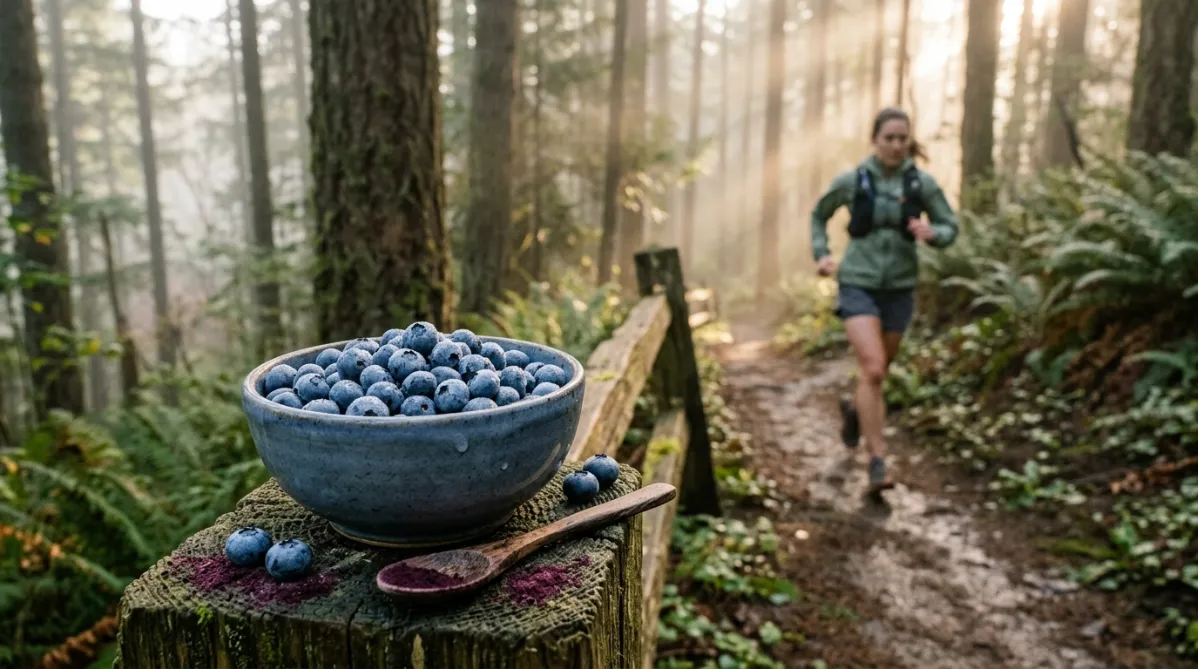
A small crossover trial found that runners finished a 22.2-km simulated trail race faster after seven days of blueberry powder than after seven days of placebo. Their heart rate and perceived effort during the race did not differ. Their legs also seemed to handle the downhill punishment better a day later. Before you stock your freezer, you should know exactly how small this study was.
The findings come from a randomized controlled trial by Giles and colleagues in the International Journal of Sport Nutrition and Exercise Metabolism (PubMed; DOI).
What the Researchers Tested
Trail running, especially with downhill sections, can cause muscle damage, oxidative stress, and inflammation. The authors note these are factors linked to fatigue. Blueberries are rich in antioxidants, so the team asked whether a short supplementation window could blunt the damage and improve performance.
Nine experienced runners completed a 22.2-km simulated trail race after 7 days of freeze-dried highbush blueberry powder (BLU) and after 7 days of placebo powder (PLA). Each runner appears to have done both conditions. That design lets every athlete serve as their own control, which is useful when the sample is small.
Researchers measured a wide panel before the race, immediately after, and 24 hours later:
- Symptoms and muscle soreness
- Pulse wave analysis and pulse wave velocity (vascular markers)
- Reactive strength index and drop jump height (neuromuscular function)
- Pulmonary function
- Salivary cortisol and immunoglobulin A
- Fraction of exhaled nitric oxide, pre- and postrace
During the race, they tracked heart rate and ratings of perceived exertion for the legs and lungs.
The Headline Result: Faster Without Working Harder
Race time was significantly faster with blueberries (p = .003). Heart rate and ratings of perceived exertion during the race did not differ between conditions. The runners went faster without reporting that it felt harder or showing a higher cardiac cost, at least by those measures.
The abstract does not report the size of the time difference, so don't assume it is large. The p-value tells you the difference was unlikely to be chance within this sample. It does not tell you how many minutes were saved.
The Recovery Clues
Several secondary findings favored blueberries:
- Supine heart rate was lower in BLU (p = .031).
- Feelings of tiredness were lower in BLU (p = .005).
- FEV1/FVC, a pulmonary function ratio, was higher in BLU (p = .023).
- Drop jump height fell 24 hours after the race in PLA (p = .022) but was preserved in BLU.
The drop jump result is the most relevant to the downhill recovery question. It suggests the explosive, stretch-shortening capacity of the legs held up better the day after the race when runners had taken blueberries. The authors concluded that supplementation improved performance "without increasing physiological or perceptual stress."
Practical Takeaways
Dose: The abstract does not state the gram amount, so I can't give you the study's number. Check the full paper before copying a protocol. The form used was freeze-dried highbush blueberry powder, not fresh fruit or extract.
Timing: Runners supplemented for 7 consecutive days leading into the race. Recovery was assessed immediately afterward and at 24 hours. This was a short-term loading approach, not a single pre-race dose.
Who it may suit: Experienced runners preparing for a hilly or downhill-heavy race, where muscle damage and next-day fatigue matter. That is the population studied.
Who should be cautious or skip it: The paper's abstract doesn't cover safety exclusions, so this is general advice. Anyone with a fruit allergy, a sensitive gut, or a medical condition requiring carbohydrate or dietary management should talk to a clinician or dietitian first. Beginners and non-runners are outside what this study tested.
The Fine Print: Nine Runners
This is the part that should temper the excitement. Nine participants is a very small sample. Small trials can overstate effects, and results may not generalize to women, older runners, novices, or longer races. The race was simulated, not a real competition. The abstract also doesn't highlight differences in markers like salivary cortisol or immunoglobulin A, so the claim of "no added stress" means those measures didn't show harm, not that blueberries cut stress across the board. Several outcomes were tested at once, and the abstract doesn't say how that was handled statistically.
Bottom Line
This is a promising, hypothesis-building study, not a mandate. A week of freeze-dried blueberries was linked with faster trail-race performance, lower tiredness, and better-preserved jump performance the next day, with no cost in perceived effort. If you're a healthy runner and like blueberries, it's a low-risk experiment for your next hilly race. Treat it as an experiment, and wait for larger replications before calling it a performance hack.
Source: Giles et al., "Seven Days of Highbush Blueberry Supplementation Improves Trail Running Performance in Experienced Runners Without Elevating Physiological or Perceptual Stress Markers," Int J Sport Nutr Exerc Metab. PubMed 42521198.