Dr. Gymbro
←

#sodium bicarbonate

3 articles
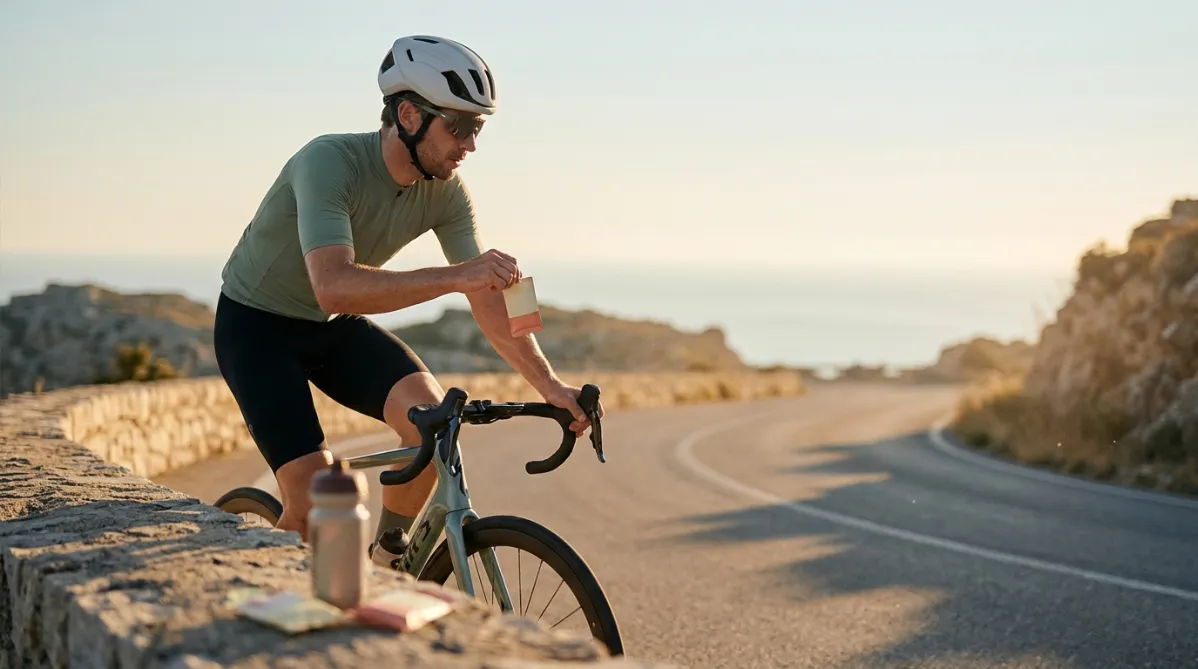
A cyclist in profile, riding a sleek road bike along a quiet coastal road in warm golden-hour light, shot from a low side angle with a shallow depth of field. The rider wears a muted sage-green jersey, black bib shorts, a matte white helmet, and sunglasses. Their face shows calm, focused fatigue, with a faint sheen of sweat on the forearms. One hand is lifted slightly from the handlebars, holding a small, unbranded matte gel packet in soft cream and coral tones, just before opening it. The road curves gently behind them toward a hazy, softly blurred horizon of pale sea and distant hills, with long amber shadows stretching across the asphalt.

In the foreground, slightly out of focus, a few gel sachets and a bike bottle rest on a weathered stone wall at the left edge of the frame, adding editorial depth. Fine dust and sunlight glow in the air. The palette is warm and restrained: butter yellow, soft peach, sage, and slate blue, with gentle film-like grain. The composition leaves open negative space in the upper right, a pale gradient sky, for headline overlay. The overall look is a modern, minimalist sports-science magazine photograph: natural, premium, and clean, with realistic textures, cinematic but understated color grading, and no text, logos, or graphics.
nutrition

Des gels contenant du bicarbonate pris en cours d'effort augmentent de 12 W la puissance lors d’un test cycliste de 3 heures

BY DR. GYMBRO ·

Et si le meilleur moment pour consommer du bicarbonate n’était pas avant la course, mais pendant ? Un essai randomisé croisé auprès de 11 cyclistes entraînés a comparé des gels au bicarbonate et aux glucides pendant trois heures de vélo. Après l’effort, la puissance moyenne sur un test de 12 minutes était supérieure de 12 W par rapport aux seuls glucides, sans différence de troubles gastriques. Aucun avantage n’a été observé sur les sprints ni sur les efforts de deux minutes, et l’échantillon reste très restreint.
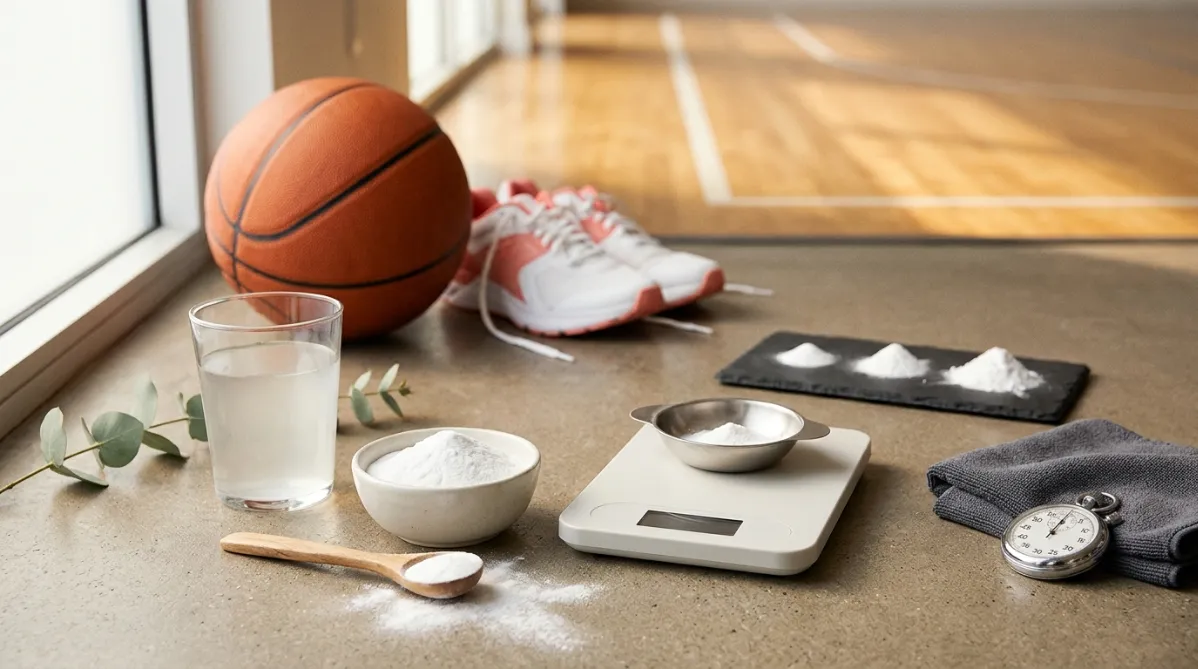
A wide, editorial-style still life shot from a slightly elevated angle on a pale, warm-gray concrete surface lit by soft natural window light from the left. In the center foreground, a clear glass of cloudy water sits beside a small white ceramic bowl heaping with fine white baking soda powder, a wooden measuring spoon resting beside it with a light dusting of powder spilling across the surface in a graceful arc. Next to them, a minimalist digital kitchen scale in matte white shows a small portion of powder in a shallow dish. Slightly behind, an orange basketball is partially in frame, its pebbled texture catching the light, resting beside a pair of clean white and coral athletic sneakers with the laces loosely undone. A folded charcoal gray towel and a stainless steel stopwatch lie to the right, the stopwatch face crisp and legible. Three small, neatly arranged piles of white powder on a slate tile in the midground, in ascending sizes, hint at different doses without any text or labels. In the soft-focus background, the faint outline of an indoor basketball court with warm honey-colored hardwood floor and blurred lane lines stretches across the frame, glowing with golden-hour light. The color palette is restrained and modern: warm off-white, soft gray, burnt orange, and touches of sage green from a single sprig of mint or eucalyptus laid near the glass. Shallow depth of field, crisp textures on powder grains and the ball's surface, gentle shadows, subtle film-like grain. Clean negative space in the upper right for headline overlay. The mood is calm, sleek, and contemporary, like a premium health and sports science magazine cover, with a fresh, minimalist composition and no people, no text, and no futuristic elements.
nutrition

Bicarbonate de soude + sprints : la dose qui a surpassé le placebo à chaque test

BY DR. GYMBRO ·

Un nouvel essai randomisé chez des basketteurs a montré que l’ajout de bicarbonate de soude pendant quatre semaines d’entraînement sprint a surpassé le placebo sur le saut, le sprint, l’agilité, la distance Yo‑Yo et la puissance Wingate. La dose plus élevée, 0,45 g/kg, a dépassé 0,3 g/kg sur chaque critère. Il s’agit donc d’un complément peu coûteux et tentant pour les athlètes de sports d’équipe, mais il peut provoquer des troubles gastriques, et l’étude est petite, courte et n’a porté que sur des hommes. Voici les calculs de dose, des astuces pour limiter les effets digestifs, et à qui cela s’adresse réellement.
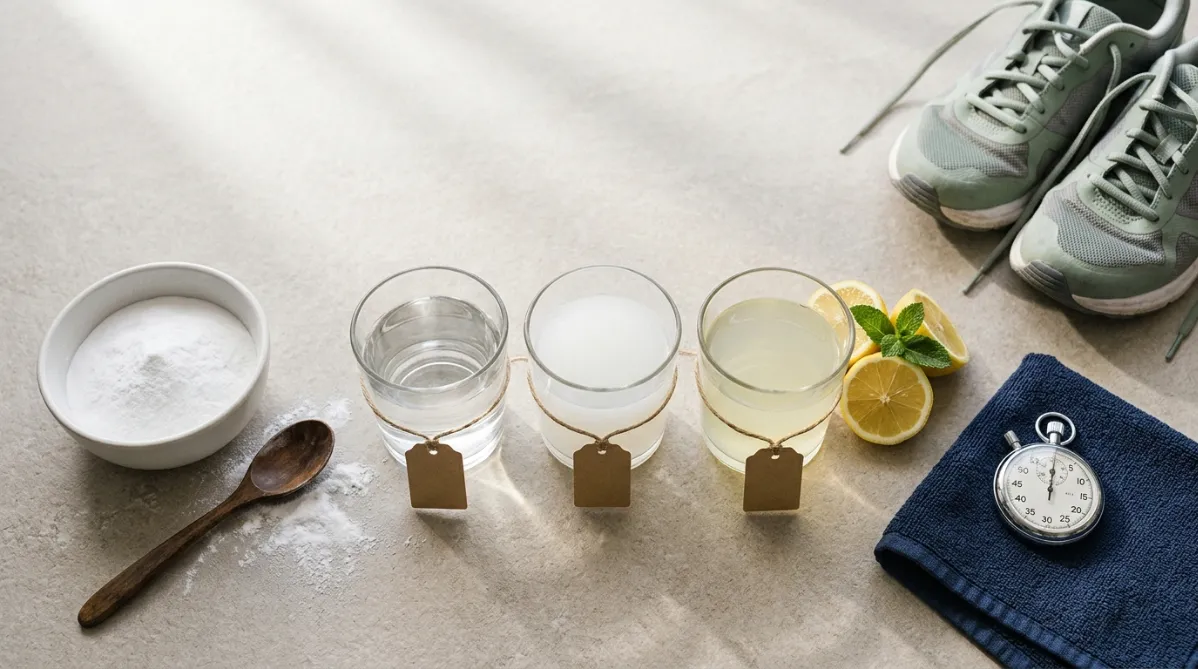
A wide, editorial-style flat lay photographed from above on a pale warm-gray stone countertop in soft morning window light. On the left, a simple white ceramic bowl holds fine white baking soda powder, with a vintage wooden spoon resting beside it and a light dusting of powder spilling across the surface. In the center, three identical clear glass tumblers sit in a neat row, each filled with a slightly different cloudy liquid: one almost clear, one milky white, one faintly yellow-tinged. Small kraft paper labels tied to the glasses with twine remain blank. To the right, a minimalist silver stopwatch lies on a folded navy athletic towel, its hands frozen mid-count. A few fresh lemon halves and a single sprig of mint add a bright, natural accent near the citrate glass. A pair of worn but clean women's running shoes sits partly in frame at the upper right corner, laces loose, hinting at an athlete without showing a person. Subtle long shadows fall diagonally across the scene, giving depth and a calm, modern feel. The color palette is muted and cohesive: chalky whites, soft sage green, warm sand, deep navy, and small pops of lemon yellow. Shallow depth of field gently blurs the edges, with crisp focus on the center glasses and stopwatch. Plenty of clean negative space across the top third leaves room for a headline overlay. The overall look is a trendy health and performance journal: clean, tactile, slightly grainy film-like texture, natural and understated, with no text, no logos, and no futuristic elements.
nutrition

Le bicarbonate de soude bat le citrate de sodium et le combo de 17 secondes

BY DR. GYMBRO ·

On suppose généralement que combiner deux agents tampons est plus efficace qu’un seul. Dans une étude croisée portant sur dix sportives de CrossFit très entraînées, le bicarbonate de soude a réduit le temps du contre‑temps de 6 km de 21,5 s par rapport au placebo, tandis que le citrate de sodium et le mélange n’ont montré aucun avantage. Le bicarbonate a aussi dépassé le citrate de 11,6 s et le combo de 17,2 s, mais au prix d’une gêne gastrique accrue. Voici ce que la recherche a révélé, pourquoi le combo a échoué, et comment l’essayer en toute sécurité.

This page is available in