Dr. Gymbro
←

#betaine

2 articles
A sun-lit editorial still life on a pale oak gym bench: a loaded barbell rests on a rack just above it, chalk dust drifting in the air. In the foreground sits a small ceramic bowl of roasted beets, some sliced to show their deep magenta rings, with a few whole beets still wearing their leafy burgundy stems. Next to the bowl is a matte white supplement tub with a minimal label, a wooden scoop of fine white powder, and a clear glass of water catching soft highlights. A slim notebook lies open beside them with a simple hand-drawn bar graph and a pen, suggesting data and analysis without any readable text. Behind the bench, a softly blurred minimalist training space: raw concrete wall, tall window with warm morning light, a rack of black dumbbells fading into bokeh. The palette is earthy and modern: beet magenta, warm cream, charcoal, brushed steel, and touches of sage green from the beet leaves. Soft directional light from the left creates long gentle shadows and a slight film-grain texture. Shallow depth of field keeps the beets and powder tack sharp. The composition is wide and balanced, with negative space on the right for headline overlay. The overall feel is a clean, contemporary health and fitness journal photograph, warm and tactile, with an understated scientific tone.
nutrition

La bêtaïne augmente la puissance du bench‑throw d’environ 16 % en 14 jours

BY DR. GYMBRO ·

Deux semaines de supplémentation en bêtaïne, un composé dérivé de la betterave commercialisé sous le nom de TMG, ont entraîné une hausse d’environ 16 % de la puissance au bench‑throw dès le premier jour d’un bloc d’essai intensif chez des hommes pratiquant la musculation. Un essai randomisé, double‑aveugle et croisé a également montré une force isométrique au développé couché accrue, ainsi que des améliorations plus modestes de la puissance du saut vertical et de la force isométrique au squat. En revanche, le nombre de répétitions et la puissance du squat‑jump sont restés stables, et l’étude ne comptait que 12 participants. Voici les données, la dose utilisée et ce que les haltérophiles peuvent vraiment en déduire.
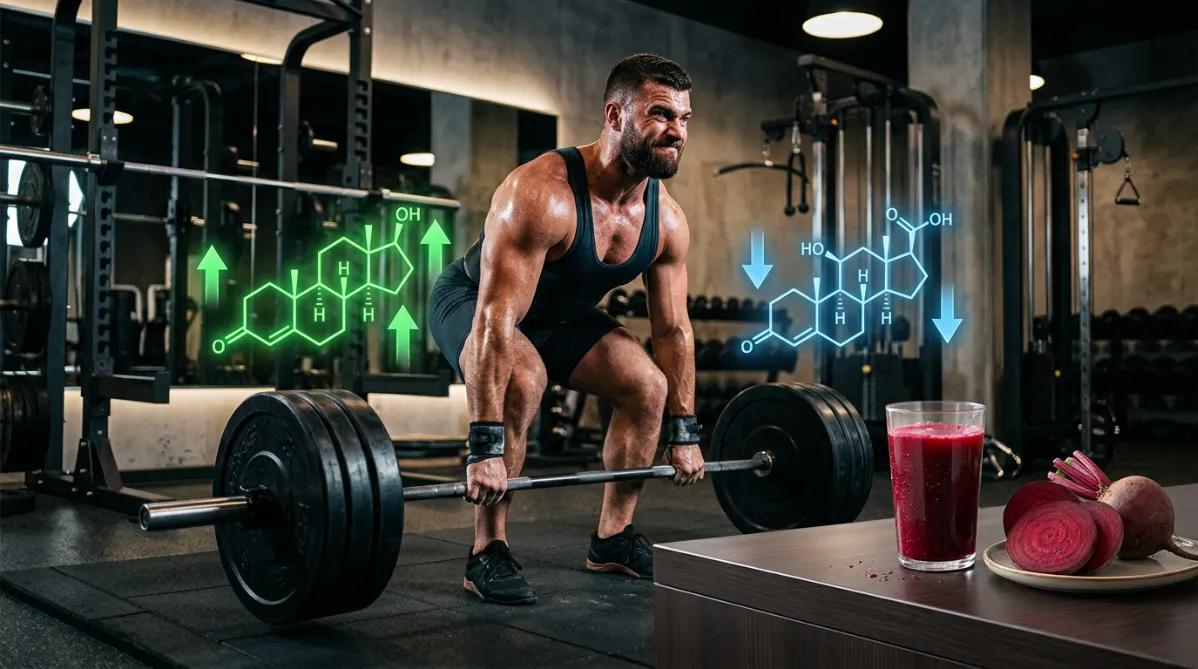
A muscular athlete in a modern gym performing a powerful deadlift, with intense focus and determination on their face. Sweat glistens on their skin as they grip a loaded barbell. In the foreground, a glass of deep red beet juice sits on a sleek counter, with fresh beetroot slices arranged nearby. The background features state-of-the-art gym equipment with soft lighting creating dramatic shadows. Overlaid translucent graphics show testosterone and cortisol molecular structures floating in the air, with upward arrows for testosterone (in vibrant green) and downward arrows for cortisol (in calming blue). The overall color palette combines deep reds from the beets, metallic grays from the gym equipment, and energetic greens and blues from the hormone visualizations, creating a scientific yet powerful atmosphere that represents the intersection of nutrition science and athletic performance.
general

Le secret scientifique pour maximiser la testostérone et écraser le cortisol : comment la bêtaïne transforme vos hormones d’entraînement

BY DR. GYMBRO ·

Des recherches récentes montrent que la supplémentation en bêtaïne peut augmenter significativement le taux de testostérone tout en atténuant la réponse corticosique chez les athlètes de force, créant ainsi un environnement hormonal optimal pour la croissance musculaire et la récupération. Ce composant naturel, présent dans les betteraves et d’autres aliments, agit sur plusieurs voies pour améliorer le profil hormonal anabolique, ce qui conduit à de meilleures adaptations à l’entraînement. Avec seulement 2,5 g par jour, les pratiquants constatent des gains mesurables de force, de composition corporelle et de récupération, grâce à la capacité unique de la bêtaïne d’élever simultanément la testostérone et de modérer l’augmentation du cortisol après des séances d’entraînement intenses.

This page is available in