Dr. Gymbro
←

#leucine

2 articles
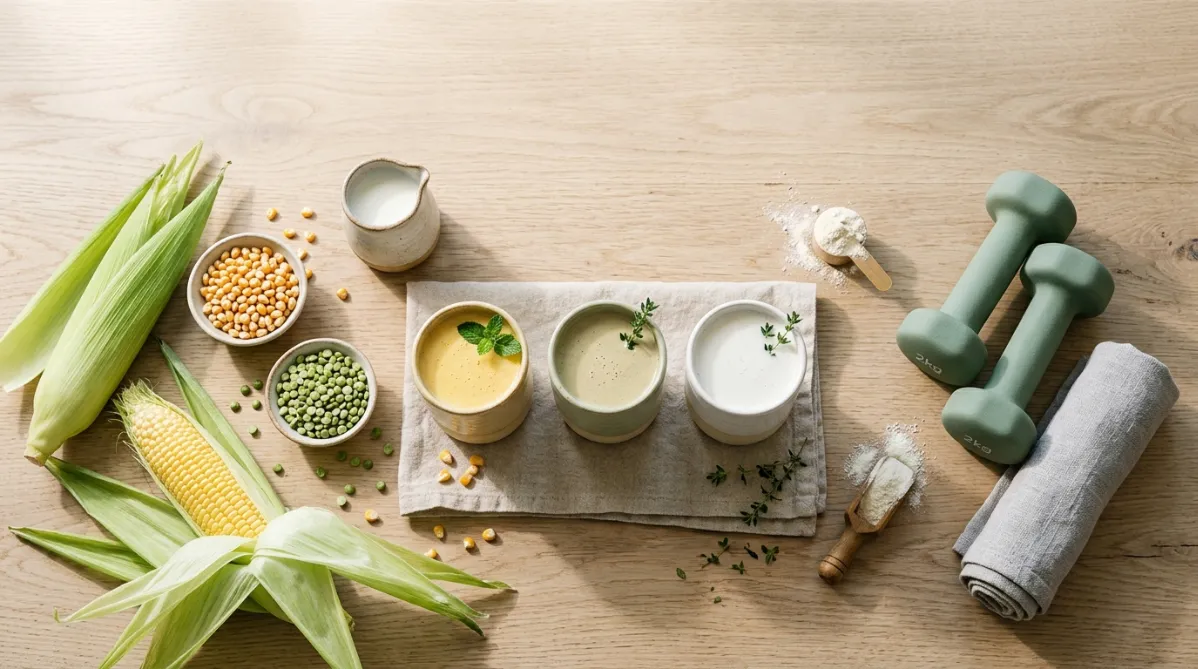
A bright, airy overhead flat-lay on a pale oak wooden table in soft morning daylight. At the center, three matching ceramic glasses in a neat row, each holding a creamy shake in a slightly different tone: one warm golden-yellow, one soft sage green-beige, one pure milky white. Beside the glasses, small shallow ceramic bowls hold the raw sources: dried yellow corn kernels, split green peas, and a small pitcher of fresh milk. A few fresh corn husks and a single ear of corn with pale green leaves are arranged diagonally across the left side of the frame, while a sprig of fresh herbs adds a touch of green. On the right, a pair of matte sage-green dumbbells and a rolled linen towel suggest light resistance exercise, placed with calm, editorial restraint. A linen napkin, a wooden scoop dusted with fine powder, and a few scattered kernels add natural texture. The color palette is warm cream, butter yellow, muted sage, and soft white, with gentle natural shadows falling to the lower right. Shallow depth of field, clean negative space at the top for headline overlay, minimalist modern magazine styling, crisp food-photography look, subtle film-like grain, wide landscape composition.
nutrition

La protéine végétale qui égalise le lait pour la synthèse musculaire

BY DR. GYMBRO ·

On pense généralement que les protéines végétales sont moins efficaces que le lait pour développer les muscles, mais une nouvelle étude menée chez des seniors montre que la protéine de maïs ne fait pas exception. Dans un essai randomisé portant sur 48 volontaires en bonne santé d’environ 68 ans, 20 g de protéine de maïs, un mélange pois‑maïs, et la protéine du lait ont tous stimulé la synthèse des protéines musculaires bien au‑delà du placebo, sans différence notable entre les groupes. L’exercice de résistance a amplifié la réponse dans chaque groupe. Voici la dose, les chiffres, les profils auxquels cela peut convenir et les mises en garde avant de changer votre shake.
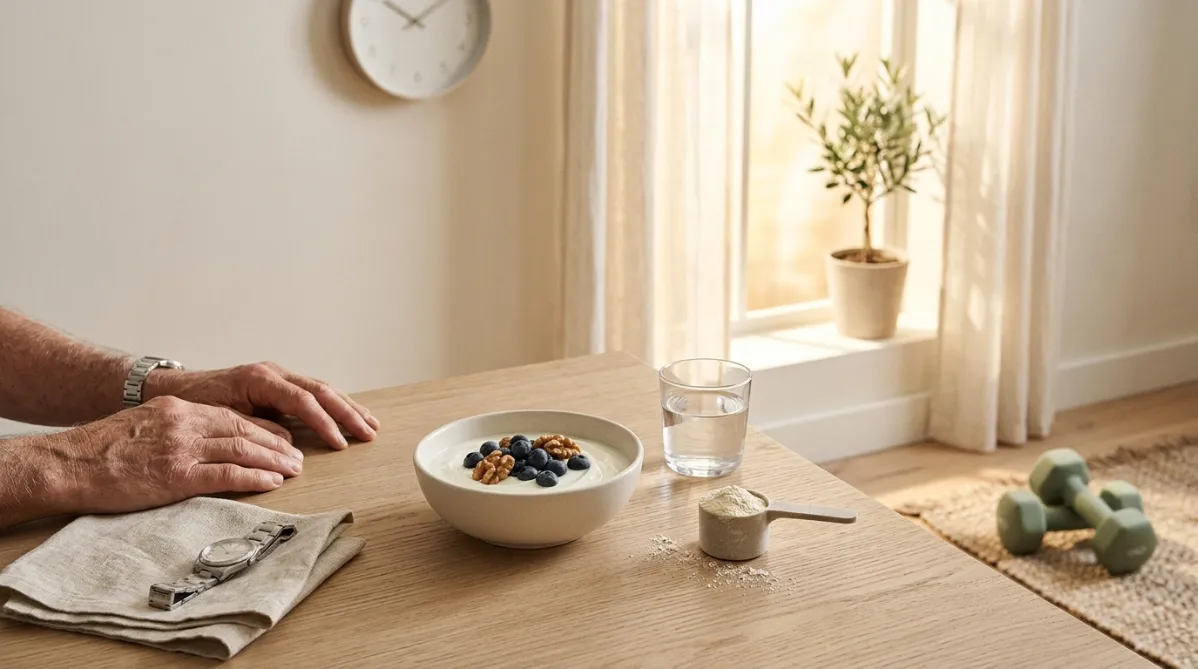
A landscape editorial photograph of a sunlit kitchen table in soft morning light, styled like a modern wellness journal cover. In the center sits a simple white ceramic bowl of plain Greek yogurt topped with walnuts and blueberries. Beside it are a small glass of water and a matte stone scoop holding a pale powder, with a few loose grains scattered on a light oak surface. To the left, a pair of weathered hands, clearly an older man's with silver hair on the wrist, rests near a neatly folded linen napkin and a slim stainless steel wristwatch. To the right, a pair of modest hex dumbbells in muted sage green sits on a woven rug at the edge of the frame, slightly out of focus, hinting at strength training. In the background, a tall window with sheer curtains lets in warm golden light, and a small potted olive plant stands on the sill. A minimalist analog clock on the wall is softly blurred, suggesting fasting windows without being literal. The palette is calm and earthy: warm cream, oatmeal, sage green, soft terracotta, and pale wood tones. The composition uses generous negative space on the upper left for headline overlay, shallow depth of field, and gentle natural shadows. The style is clean, contemporary, and slightly muted, like a lifestyle magazine or health journal feature, shot on a 50mm lens with soft film-like grain. Calm, thoughtful, and quietly authoritative, with no text, logos, or futuristic elements.
nutrition

Leucine vs Protéine dans les régimes de jeûne : résultat surprenant chez les hommes âgés

BY DR. GYMBRO ·

On surnomme souvent la leucine l'« interrupteur maître » de la synthèse musculaire ; on s'attend donc à ce qu'elle protège les hommes plus âgés qui pratiquent le jeûne. Une étude randomisée de 28 jours menée chez 61 hommes âgés suivant un jeûne un jour sur deux a comparé des compléments de leucine et de protéines à un groupe contrôle. Tous les groupes ont vu leurs forces, leurs fonctions, leur tension artérielle et leurs lipides s'améliorer, et les suppléments n'ont apporté aucun avantage mesurable sur la plupart des critères. Voici les doses testées, qui pourrait encore en tirer profit, qui peut s’en passer, et les limites de l’étude.

This page is available in